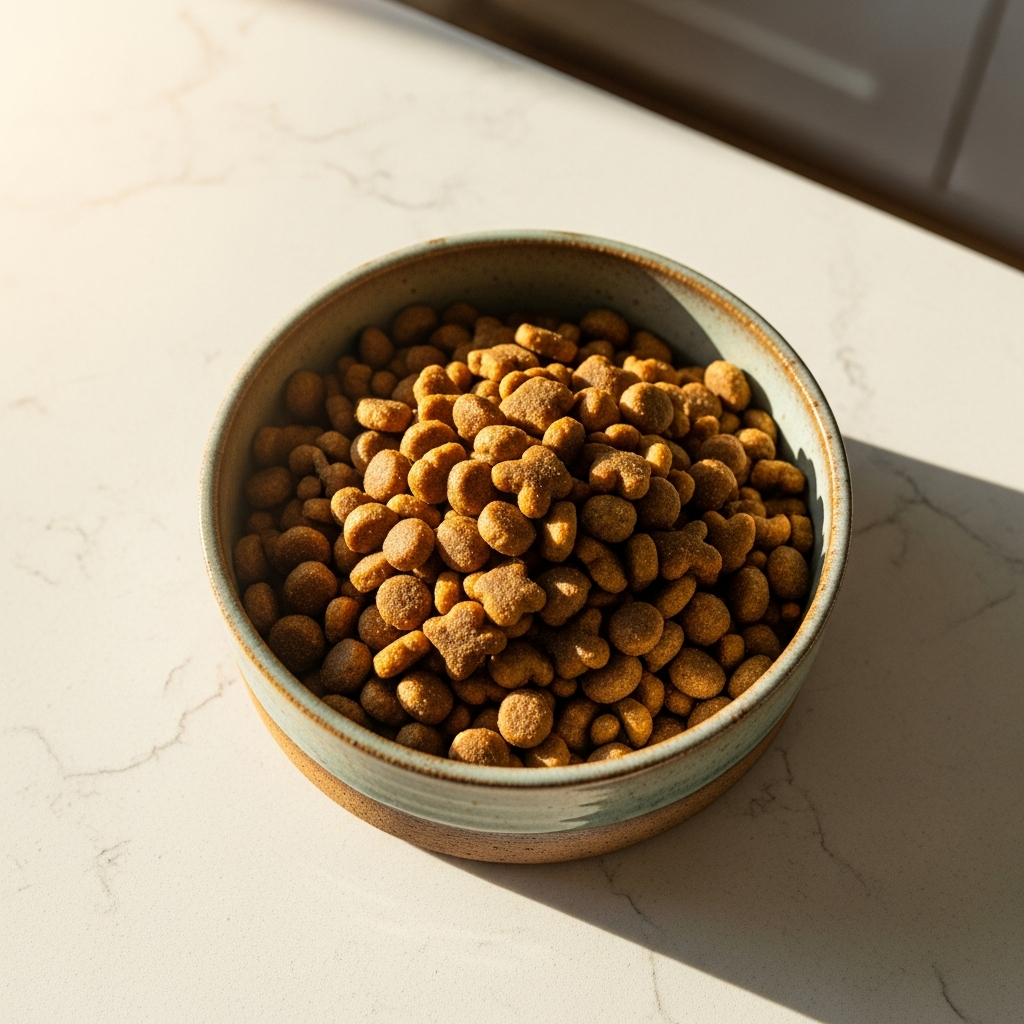
Dry dog food is still the most practical way to feed most dogs. It is shelf-stable, affordable relative to other formats, easy to portion, and available in hundreds of formulas. The problem is not finding dry food – it is finding the right dry food in a market designed to confuse you.
I have spent months comparing labels, researching manufacturer practices, and feeding different formulas to real dogs. This guide cuts through the noise and gives you our top picks at every price point, along with the knowledge to evaluate any bag you pick up.
How We Evaluated These Foods
Every food on this list was evaluated against five criteria:
- Ingredient quality: Named animal proteins in the first two positions, named fat sources, identifiable whole food ingredients
- AAFCO adequacy: Must carry a nutritional adequacy statement for the appropriate life stage
- Manufacturer reputation: Preference for companies that employ board-certified veterinary nutritionists, conduct feeding trials, and own their manufacturing facilities
- Real-world palatability: Dogs actually need to eat it. We considered owner reviews and real-world feeding data
- Value: Nutritional quality relative to price per serving
We did not accept free products or sponsorships for this list. Affiliate links are used, which means we may earn a small commission if you purchase through our links, but this does not influence our rankings or recommendations.
Prices last updated February 2026.
Our Top Picks at a Glance
| Pick | Best For | Price Range | Protein Source |
|---|---|---|---|
| Purina Pro Plan Savor | Best Overall Value | $$ | Chicken |
| Diamond Naturals | Best Budget | $ | Chicken/Lamb |
| Taste of the Wild | Best Mid-Range | $$ | Roasted Bison/Venison |
| Orijen Original | Best Premium | $$$$ | Free-Run Chicken/Turkey |
| Victor Purpose Nutra Pro | Best for Active Dogs | $$ | Beef/Chicken |
Best Overall Value: Purina Pro Plan Savor Shredded Blend
Purina Pro Plan is not the most exciting name in dog food. There are no rustic farmhouse photos on the bag. But here is what it does have: formulation by a team of board-certified veterinary nutritionists, extensive feeding trials (not just lab analysis), and decades of manufacturing consistency.
Key ingredients: Chicken, rice, whole grain wheat, poultry by-product meal, soybean meal
Guaranteed analysis:
- Crude protein: 26% minimum
- Crude fat: 16% minimum
- Crude fiber: 3% maximum
- Moisture: 12% maximum
What we like:
- Backed by more feeding trial data than almost any other brand
- Shredded pieces mixed with kibble improve palatability
- Available in multiple protein and size-specific formulas
- Price point accessible for virtually any budget
- Real chicken is the first ingredient
What could be better:
- Contains poultry by-product meal (nutritious but unappetizing on paper)
- Contains corn and wheat, which some owners prefer to avoid
- Not grain-free (though for most dogs, this is fine – see our grain-free dog food guide)
Our take: If you want to feed your dog what most veterinary professionals would recommend for a healthy adult dog, Pro Plan is the answer. It is not glamorous. It just works.
Best Budget: Diamond Naturals Adult Chicken and Rice
If you are feeding a large dog or multiple dogs and need to keep costs reasonable without sacrificing nutrition, Diamond Naturals is the sweet spot.
Key ingredients: Chicken, chicken meal, whole grain brown rice, cracked pearled barley, ground white rice
Guaranteed analysis:
- Crude protein: 26% minimum
- Crude fat: 16% minimum
- Crude fiber: 3.5% maximum
- Moisture: 10% maximum
What we like:
- Real chicken as the first ingredient with chicken meal as a concentrated protein booster
- Includes probiotics for digestive support
- Added omega fatty acids from salmon oil
- Superfoods like chia seed and quinoa
- Significantly lower price per pound than premium brands
What could be better:
- Diamond Pet Foods has had recalls in the past (most recently for Salmonella in 2012)
- Not as many specialized formulas as larger brands
- Fewer feeding trial studies published compared to Purina or Hill’s
Our take: At this price point, the ingredient quality is genuinely impressive. Diamond does not cut corners where it counts – the protein sources are real and identifiable, and the nutrient profile is solid.
Best Mid-Range: Taste of the Wild High Prairie
Taste of the Wild has built a loyal following by offering novel protein sources at a price that does not require a second mortgage. Their High Prairie formula uses roasted bison and venison as primary proteins.
Key ingredients: Buffalo, lamb meal, chicken meal, sweet potatoes, peas
Guaranteed analysis:
- Crude protein: 32% minimum
- Crude fat: 18% minimum
- Crude fiber: 3% maximum
- Moisture: 10% maximum
What we like:
- Novel proteins (bison, venison) are great for dogs sensitive to chicken or beef
- Higher protein content than most mid-range options
- Grain-free with sweet potato and pea-based carbohydrates
- Added probiotics
- Competitive pricing for the ingredient quality
What could be better:
- Grain-free formula – while the DCM connection is not definitively proven, some owners prefer grain-inclusive
- Peas and legumes are prominent in the formula
- Manufactured by Diamond Pet Foods (same recall history concern)
Our take: For dogs who do well on grain-free diets or who need a novel protein source, this is one of the best values available. Just be aware of the ongoing grain-free conversation and discuss it with your vet.
Best Premium: Orijen Original
Orijen is what happens when you take the “biologically appropriate” philosophy to its logical extreme. This food is made with up to 85% animal ingredients from free-run chicken and turkey, wild-caught fish, and cage-free eggs.
Key ingredients: Deboned chicken, deboned turkey, Atlantic flounder, whole eggs, whole Atlantic mackerel
Guaranteed analysis:
- Crude protein: 38% minimum
- Crude fat: 18% minimum
- Crude fiber: 5% maximum
- Moisture: 12% maximum
What we like:
- Exceptionally high meat inclusion with multiple protein sources
- WholePrey philosophy includes organs, cartilage, and bone for natural nutrient delivery
- No synthetic amino acid supplements needed because of the meat density
- Manufactured in their own purpose-built kitchens
- Protein content that rivals some raw diets
What could be better:
- Premium pricing – a 25 lb bag can run $80-100+
- Very rich formula can cause digestive upset in dogs not used to high-protein food
- Grain-free
- May be more protein than a sedentary dog needs
Our take: If budget is not a constraint and you want the highest meat-content kibble on the market, Orijen is the benchmark. But be honest about whether your dog needs this level of protein. A moderately active pet dog may do just as well on a more affordable option.
Best for Active Dogs: Victor Purpose Nutra Pro
Victor is a Texas-based brand that flies under the radar but has a devoted following among hunters, working dog handlers, and sport dog owners. Nutra Pro is their high-performance formula.
Key ingredients: Beef meal, chicken meal, grain sorghum, whole grain millet, chicken fat
Guaranteed analysis:
- Crude protein: 38% minimum
- Crude fat: 20% minimum
- Crude fiber: 3.5% maximum
- Moisture: 10% maximum
What we like:
- 38% protein and 20% fat for high-energy dogs
- Mineral-fortified with selenium yeast for immune support
- Includes multiple probiotics
- Grain-inclusive formula
- Outstanding value for a performance food
- Made in a company-owned facility in Texas
What could be better:
- Meal-based proteins (beef meal, chicken meal) rather than whole meats
- Rich formula can cause weight gain in less active dogs
- Limited availability in some regions
Our take: If your dog has a job – hunting, agility, herding, or just being genuinely active every day – this formula delivers the caloric density they need. It is not the right choice for a dog who mostly naps.
How to Read a Dry Dog Food Label
Understanding the label empowers you to evaluate any food, not just the ones on this list. Here is what to look for.
The Ingredient List
Ingredients are listed by weight in descending order. But there is a catch: fresh meats (listed as “chicken” or “beef”) contain about 70% water. After cooking, their actual contribution by weight drops significantly. This is why you often see a named meat first, followed by a meat meal – the meal is the real protein driver.
Red flags on the ingredient list:
- Generic terms like “meat,” “poultry,” or “animal fat” (no species identified)
- Multiple corn or wheat derivatives listed separately (ingredient splitting)
- Artificial colors (dogs do not care about food color)
- Sugar, corn syrup, or other sweeteners
- Propylene glycol (a moisture-retaining agent used in some soft kibble)
The AAFCO Statement
Look for one of these two types of statements:
- Formulated to meet: The food’s recipe has been analyzed and meets AAFCO nutrient profiles. This is the minimum standard.
- Animal feeding tests: The food has been fed to actual dogs in controlled trials and demonstrated nutritional adequacy. This is the gold standard.
The Guaranteed Analysis
The guaranteed analysis tells you the minimum protein and fat, and maximum fiber and moisture. But comparing foods based on guaranteed analysis alone can be misleading because of moisture differences. Always convert to dry matter basis for accurate comparisons (see our main dog food guide for the conversion formula).
Common Kibble Myths Debunked
“Grain-free is always better”
Not true. Most dogs digest grains efficiently, and grains provide valuable nutrients and fiber. The grain-free trend was largely marketing-driven. Unless your dog has a diagnosed grain sensitivity, grain-inclusive foods are perfectly appropriate. Read more in our grain-free dog food guide.
“By-products are garbage”
By-products include organ meats like liver, kidney, and heart – which are actually nutrient-dense foods. Named by-products (like “chicken by-product meal”) from reputable manufacturers are a legitimate protein source. The concern is with unnamed, generic “meat by-products” from unspecified sources.
“The first ingredient is what matters most”
The first ingredient matters, but it does not tell the whole story. A food listing “fresh chicken” first might have less total animal protein than a food listing “chicken meal” first, because the fresh chicken loses most of its weight after cooking. Look at the overall ingredient panel, the guaranteed analysis, and the company’s nutritional philosophy.
“More protein is always better”
Healthy adult dogs need adequate protein, not maximum protein. A sedentary 10-year-old Shih Tzu does not benefit from 40% protein the same way a working sled dog does. Excess protein in a low-activity dog gets converted to energy or fat, and it puts unnecessary work on the kidneys. Match the protein level to your dog’s actual activity level.
Feeding Tips for Dry Food
Storage
Store kibble in its original bag inside an airtight container. The bag has a protective lining that helps preserve freshness and provides important batch and lot information in case of a recall. Do not dump kibble directly into a plastic bin.
Keep the container in a cool, dry place away from direct sunlight. Heat and humidity degrade nutrients and fats, leading to rancidity.
Transitioning
If you are switching from one dry food to another, transition gradually over 7-10 days. Mix increasing proportions of the new food with decreasing proportions of the old food. Abrupt changes almost always result in digestive upset – loose stools, gas, or vomiting.
Portion Control
The feeding guidelines on the bag are starting points, not gospel. They tend to overestimate for most dogs because manufacturers have an obvious incentive for you to use more food. Use the guidelines as a starting point, then adjust based on your dog’s body condition score.
Toppers and Mix-Ins
Adding a bit of wet food, bone broth, or plain pumpkin puree to dry food can increase palatability for picky eaters and add some beneficial moisture. Just account for the additional calories in your daily total.
When to Consider Other Options
Dry food works for the majority of dogs, but it is not the right choice for every situation:
- Dogs with severe dental issues may struggle with kibble and benefit from wet food
- Dogs with chronic dehydration or kidney concerns may benefit from higher-moisture foods
- Extremely picky eaters who refuse all kibble may need fresh food delivery
- Dogs with complex allergies may need limited ingredient diets that are harder to find in kibble form
- Puppies have specific nutritional requirements covered in our puppy food guide
- Senior dogs may need age-specific formulas detailed in our senior dog food guide
Frequently Asked Questions
How long does a bag of dry dog food last once opened?
Most manufacturers recommend using opened dry food within 6 weeks. After that, fats begin to oxidize (go rancid), and nutrient potency decreases. If you have a small dog and buy large bags, consider splitting the bag and freezing what you will not use within the first month.
Should I rotate between different dry foods?
Rotation feeding – switching between two or three formulas every few months – can expose your dog to a broader range of nutrients and reduce the risk of developing sensitivities to any single protein. However, some dogs with sensitive stomachs do better on a consistent diet. If you rotate, transition gradually each time.
Is it OK to mix dry and wet food?
Absolutely. Mixing a spoonful of wet food or fresh food with kibble is a common practice that adds moisture, variety, and palatability. Just make sure both foods are complete and balanced, and account for the combined calories.
How do I know if my dog’s kibble has gone bad?
Signs of spoiled kibble include a sour or rancid smell, change in color, visible mold, or your dog suddenly refusing food they previously ate willingly. When in doubt, throw it out. Rancid fats can cause digestive problems and long-term health issues.
Are expensive brands always better than budget brands?
Not necessarily. Some of the most expensive dog foods are selling you marketing and packaging rather than superior nutrition. Brands like Purina Pro Plan, which fall in the moderate price range, invest heavily in nutritional science, feeding trials, and veterinary nutritionist oversight. Price is one factor, but it should not be the only one you consider.
Prices last updated February 2026. We update pricing and availability quarterly. Affiliate links are used – if you purchase through our links, we may earn a small commission at no additional cost to you.
This guide is for informational purposes only. Every dog is different. Consult your veterinarian for personalized dietary recommendations, especially if your dog has health conditions or special nutritional needs.