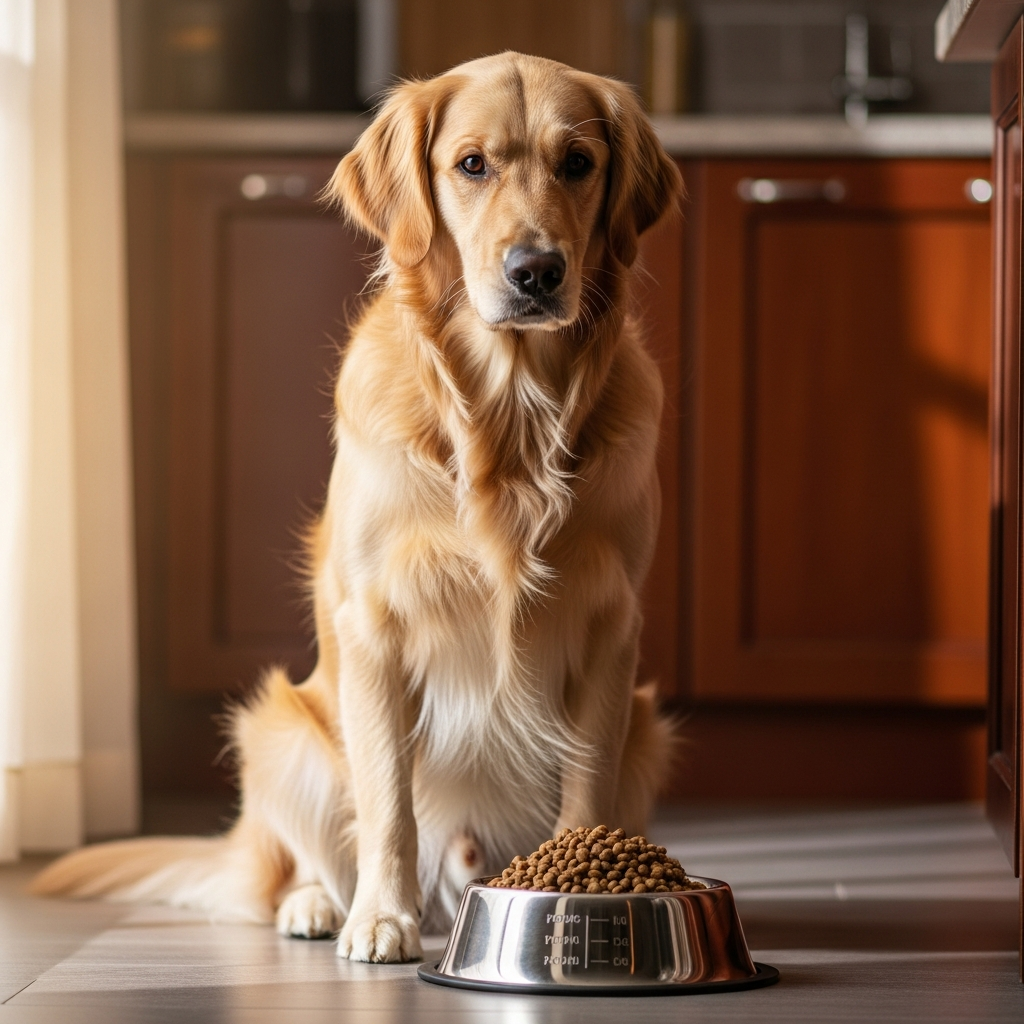
Here is a truth the dog food industry does not want you to think about too carefully: the feeding guidelines printed on every bag of dog food are almost always wrong for your specific dog.
I do not mean they are fraudulent or intentionally misleading. But those charts are designed for the broadest possible range of dogs, and they consistently err on the side of overfeeding. When you think about it, this makes sense – the company selling you dog food has a financial incentive for you to use more of it.
The result is an obesity epidemic. The Association for Pet Obesity Prevention estimates that over 50% of dogs in the United States are overweight or obese. And the number one cause is not lack of exercise or “bad” food. It is simply too much food.
This guide teaches you how to figure out exactly how much your individual dog needs, based on their body, their activity level, and their metabolism – not on a generic chart printed by a company that profits from overfeeding.
Why the Bag Guidelines Are Wrong
The feeding chart on your dog food bag typically looks something like:
| Dog Weight | Daily Amount |
|---|---|
| 10-20 lbs | 3/4 - 1 1/2 cups |
| 20-40 lbs | 1 1/2 - 2 3/4 cups |
| 40-60 lbs | 2 3/4 - 3 3/4 cups |
| 60-80 lbs | 3 3/4 - 5 cups |
The problems with this approach:
Massive ranges. A chart telling you to feed “1 1/2 to 2 3/4 cups” for a 20-40 pound dog covers an 83% range. That is not guidance; it is a guess.
Weight is not the only factor. A 50-pound Border Collie running agility courses five days a week has dramatically different caloric needs than a 50-pound Basset Hound whose daily exercise is walking to the food bowl.
The guidelines assume a “moderately active” dog. Most pet dogs in 2026 are not moderately active. They are sedentary to lightly active.
Spayed/neutered dogs need fewer calories. Most charts do not account for this, but spaying and neutering can reduce caloric needs by 20-30%.
They do not account for treats. If treats make up 10% of your dog’s daily calories (the recommended maximum), the main meal portions should be reduced by 10%.
Step 1: Body Condition Scoring
Before calculating calories, you need to know where your dog is right now. Body condition scoring (BCS) is a simple, hands-on assessment that tells you whether your dog is underweight, ideal, or overweight.
The 9-Point Scale
Most veterinarians use a 1-9 scale:
1-3: Underweight
- Ribs, spine, and hip bones clearly visible
- No palpable body fat
- Obvious loss of muscle mass
- Deep abdominal tuck
4-5: Ideal
- Ribs easily felt with light pressure but not visible
- Waist clearly visible when viewed from above
- Abdominal tuck visible from the side
- Thin layer of fat over ribs
6-7: Overweight
- Ribs difficult to feel under fat layer
- Waist barely visible or absent when viewed from above
- Minimal abdominal tuck
- Fat deposits along the spine and base of tail
8-9: Obese
- Ribs cannot be felt under thick fat layer
- No waist visible – barrel-shaped when viewed from above
- No abdominal tuck – belly may hang
- Obvious fat deposits on neck, limbs, and base of tail
How to Score Your Dog
Do this with your hands, not just your eyes (particularly for fluffy breeds):
Ribs: Place your hands on your dog’s sides with your thumbs on the spine. Can you feel individual ribs with gentle pressure? If you have to press hard, the dog is likely overweight.
Waist: Look at your dog from directly above. There should be a visible narrowing behind the rib cage (an hourglass shape).
Tuck: Look at your dog from the side. The belly should curve upward from the chest to the hind legs, not hang down or form a straight line.
The target is a BCS of 4-5 out of 9. If your dog is above a 5, you need to reduce food intake. If below a 4, you need to increase it.
Step 2: Calculate Your Dog’s Caloric Needs
Once you know your dog’s current condition, you can calculate their actual caloric requirement using the Resting Energy Requirement (RER) and a multiplier based on their life stage and activity level.
The Formula
RER = 70 x (ideal body weight in kg)^0.75
Then multiply by the appropriate factor:
| Life Stage / Activity | Multiplier |
|---|---|
| Neutered adult, typical activity | 1.6 |
| Intact adult, typical activity | 1.8 |
| Light activity (short daily walks) | 1.4 |
| Moderate activity (regular exercise, play) | 1.6 |
| High activity (working dogs, agility, herding) | 2.0-3.0 |
| Weight loss needed | 1.0-1.2 |
| Puppy (4-12 months) | 2.0 |
| Puppy (under 4 months) | 3.0 |
| Senior (less active) | 1.2-1.4 |
| Pregnant (last trimester) | 1.8-2.0 |
| Lactating | 2.0-6.0 |
Example Calculation
A neutered, moderately active 50-pound (22.7 kg) dog:
- RER = 70 x (22.7)^0.75 = 70 x 10.4 = approximately 728 calories
- Daily need = 728 x 1.6 = approximately 1,165 calories per day
Compare this to the bag recommendation. Many kibbles at the “40-60 pound” range suggest amounts that deliver 1,400-1,600+ calories. That is 20-40% more than this dog actually needs.
Quick Reference Table
For neutered adults with typical activity (multiplier of 1.6):
| Ideal Weight | Daily Calories (Approx.) |
|---|---|
| 10 lbs (4.5 kg) | 340 |
| 20 lbs (9 kg) | 570 |
| 30 lbs (13.6 kg) | 760 |
| 40 lbs (18.2 kg) | 930 |
| 50 lbs (22.7 kg) | 1,090 |
| 60 lbs (27.3 kg) | 1,240 |
| 70 lbs (31.8 kg) | 1,380 |
| 80 lbs (36.4 kg) | 1,510 |
| 90 lbs (40.9 kg) | 1,640 |
| 100 lbs (45.5 kg) | 1,760 |
These are estimates. Individual metabolism varies, which is why monitoring body condition over time matters more than hitting an exact calorie number.
Step 3: Convert Calories to Cups
Now that you know how many calories your dog needs, you need to know how many calories are in each cup of your dog’s food. This information is on the bag, usually in the guaranteed analysis section or on the company’s website.
Common calorie densities:
- Budget kibble: 300-350 kcal/cup
- Mid-range kibble: 350-400 kcal/cup
- Premium kibble: 380-450 kcal/cup
- Performance/high-calorie kibble: 450-550 kcal/cup
Example
Your dog needs 1,090 calories per day. Your kibble has 380 kcal per cup.
1,090 / 380 = 2.87 cups per day, or roughly 1.4 cups per meal (fed twice daily).
Compare this to a bag that says “feed 3 1/2 to 4 cups” for a 50-pound dog. You would be overfeeding by 15-40%.
Step 4: Account for Treats
Treats are the hidden calorie bomb in most dogs’ diets. A few training treats here, a dental chew there, a piece of cheese for medication – it adds up fast.
Common Treat Calorie Counts
| Treat | Approximate Calories |
|---|---|
| Milk-Bone Original (medium) | 40 |
| Greenies Dental Chew (regular) | 90 |
| 1 tablespoon peanut butter | 95 |
| Bully stick (6 inch) | 90-130 |
| Slice of deli turkey | 25-30 |
| Baby carrot | 4 |
| Blueberries (10 berries) | 8 |
| Kong filled with peanut butter | 150-200 |
The 10% Rule
Treats should make up no more than 10% of your dog’s daily caloric intake. For our 50-pound dog eating 1,090 calories per day, that is 109 calories in treats. A single peanut butter-filled Kong nearly maxes that out.
Reduce main meal portions proportionally when treats are given. If your dog gets 100 calories in treats, reduce their food by 100 calories (about 1/4 cup of most kibble).
Low-Calorie Treat Alternatives
If you train frequently or your dog gets lots of treats, switch to lower-calorie options:
- Baby carrots (4 cal each)
- Green beans (2-3 cal each)
- Blueberries (1 cal each)
- Ice cubes (0 calories and many dogs love them)
- Their own kibble used as treats during training
- Small pieces of dehydrated liver (about 5 cal per small piece)
Step 5: Monitor and Adjust
Calorie calculations are starting points, not final answers. Your dog’s individual metabolism, activity patterns, and health status create variables that no formula can perfectly predict.
Weigh Regularly
Weigh your dog every 2-4 weeks. Most vet offices will let you use their scale for free during business hours. For smaller dogs, step on a home scale while holding the dog, then subtract your weight.
Watch the Trend
A few ounces of fluctuation is normal. What matters is the trend over weeks and months:
- Gaining weight: Reduce food by 10% and reassess in two weeks
- Losing weight: Increase food by 10% and reassess in two weeks
- Stable at ideal BCS: Maintain current portions
Seasonal Adjustments
Many dogs are more active in spring and summer and more sedentary in winter. Adjust portions accordingly – some dogs need 10-15% more food during their active season and less during the cold months.
Life Stage Transitions
Reassess caloric needs when your dog’s life stage changes:
- After spaying/neutering (reduce by 10-20%)
- Transitioning from puppy to adult food
- Entering the senior stage (typically reduce by 10-20%)
- After an injury that limits activity
- During pregnancy or lactation
For specific guidance on feeding during the first year, see our puppy food guide.
Special Situations
Feeding for Weight Loss
If your dog needs to lose weight, work with your veterinarian to set a target weight and a safe rate of loss. General guidelines:
- Use your dog’s target weight (not current weight) to calculate calories
- Use a multiplier of 1.0-1.2 for weight loss
- Aim for 1-2% body weight loss per week
- Switch to a weight management formula if possible (higher fiber, lower calorie density)
- Increase exercise gradually alongside dietary changes
- Monitor with biweekly weigh-ins
Crash dieting is dangerous for dogs. Dramatic calorie restriction can lead to muscle wasting and nutrient deficiencies. Slow, steady loss is healthier and more sustainable.
Feeding Multiple Dogs
Households with multiple dogs face unique challenges:
- Feed separately to ensure each dog gets the right amount
- Pick up bowls after 15-20 minutes to prevent slow eaters from being bullied
- Monitor each dog’s body condition independently – they likely need different portions even if they eat the same food
Feeding Working and Performance Dogs
Working dogs, competitive agility dogs, hunting dogs, and other canine athletes may need 2-3 times the calories of a typical pet dog. High-performance formulas with higher calorie density (450+ kcal/cup) reduce the volume needed. See our best dry dog food guide for performance food recommendations.
The Tools You Need
A Measuring Cup (And Not the One From Your Kitchen)
Use an actual measuring cup designed for pet food, or better yet, a kitchen scale. “One cup” scooped from the bag can vary by 20-30% depending on how packed the scoop is. Weighing food in grams is the most accurate method.
A Kitchen Scale
Weighing your dog’s food in grams eliminates the scooping inconsistency entirely. Most quality kibbles list their calorie content per gram as well as per cup. A simple digital kitchen scale costs $10-15 and pays for itself in precision.
A Notebook or App
Track what your dog eats (including treats), their weight, and their body condition score. This creates a feedback loop that lets you dial in the exact right amount over time. Several free apps (like Pet Diet Designer or Petriage) can help with tracking.
Frequently Asked Questions
How often should I feed my dog?
Most adult dogs do best on two meals per day, spaced roughly 12 hours apart. Puppies need more frequent feeding (3-4 times daily under 6 months, then transition to twice daily). Senior dogs typically do well on two meals but may benefit from three smaller meals if appetite decreases. Avoid free feeding (leaving food out all day) as it prevents portion control and makes it harder to notice appetite changes.
My dog always acts hungry. Should I feed more?
Not necessarily. Dogs are opportunistic feeders by nature and will often eat beyond their caloric needs if given the chance. If your dog is at a healthy body condition score and getting adequate nutrition, hunger behavior does not mean they need more food. However, if your dog is losing weight despite eating the recommended amount, consult your veterinarian to rule out medical causes like parasites, malabsorption, or metabolic disorders.
Should I feed based on my dog’s current weight or ideal weight?
If your dog is at a healthy weight, use their current weight. If your dog is overweight, use their ideal (target) weight for calorie calculations. Your veterinarian can help you determine an appropriate target weight based on your dog’s frame and breed.
Does the type of food affect how much I should feed?
Absolutely. Different foods have different calorie densities. A cup of premium high-protein kibble may have 450 calories, while a cup of budget kibble may have 320 calories. Always base your portions on the caloric content of the specific food you are feeding, not on a generic “cups per day” guideline.
How do I know if I am feeding the right amount?
The best indicators are your dog’s body condition score, weight stability over time, energy levels, and stool quality. A well-fed dog should have consistent energy, a shiny coat, firm stools, and a body condition score of 4-5 out of 9. If you are unsure, your veterinarian can assess your dog’s condition and recommend adjustments at your next visit.
This guide is for informational purposes only. Every dog is different, and individual caloric needs can vary significantly based on breed, age, health status, and activity level. Consult your veterinarian for personalized feeding recommendations, especially if your dog needs to lose or gain weight.