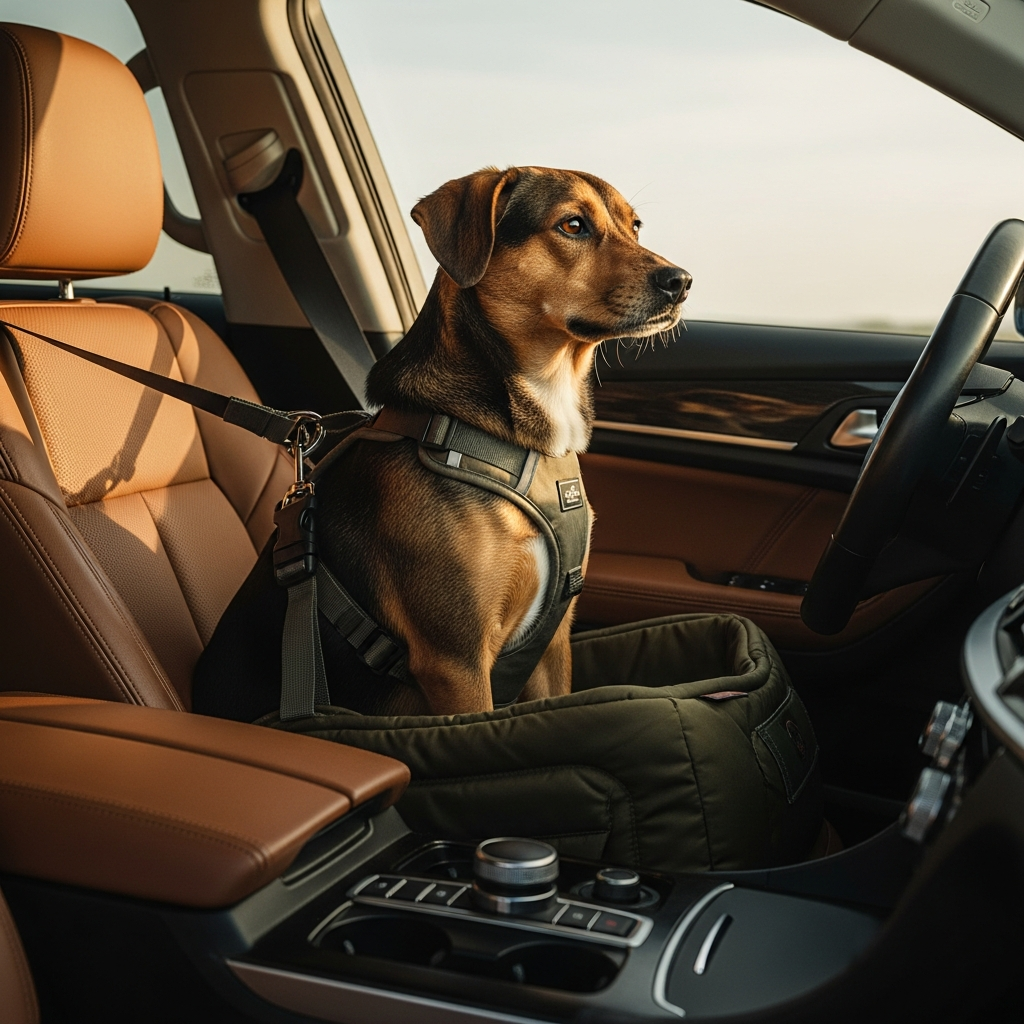
Here’s a number that should bother you: an unrestrained 60-pound dog in a 35 mph crash becomes a 2,700-pound projectile. That’s enough force to kill a passenger, break through a windshield, or both. Yet most dog owners drive with their dogs completely unsecured, sitting on the backseat or riding on someone’s lap.
A car harness is the seatbelt for your dog. But here’s the problem — most car harnesses on the market have never been crash tested. They look like safety gear. They’re marketed as safety gear. But without crash testing, they’re just regular harnesses with a seatbelt attachment that may or may not survive an actual impact.
This guide focuses on the harnesses that have been tested and the ones worth your money, plus everything you need to know about fitting and using them correctly.
Planning a longer drive? Pair this guide with our road trip with your dog checklist for the complete picture.
The Crash Testing Problem
The pet product industry has no federal crash testing requirement. None. Unlike car seats for children, which must meet rigorous federal standards before they can be sold, dog car harnesses have zero regulatory oversight.
The only independent crash testing program is run by the Center for Pet Safety (CPS), a nonprofit that uses the same crash test protocols developed for child car seats, adapted for pets. Their testing is rigorous: a motorized sled simulates a 30 mph frontal crash, and the harness must keep the dog (a weighted crash test dummy) contained within the vehicle with controlled movement.
Very few harnesses pass. Many that claim to be “crash tested” have only been tested by the manufacturer under unverified conditions. CPS certification is the gold standard, and it’s the only testing I trust.
Best Crash-Tested Car Harnesses
1. Sleepypod Clickit Sport — Best Overall
Price: $75–$90 | CPS rating: 5 stars | Sizes: XS to L
The Clickit Sport is the only car harness to receive a five-star rating from the Center for Pet Safety. That alone puts it in a category of its own.
What I like:
- Five-star CPS crash test certification — the highest rating any pet restraint has received
- Three-point connection system that distributes crash forces across the strongest parts of the dog’s body (shoulders and chest)
- The padded vest design is comfortable enough for short walks, so you don’t need to swap harnesses between the car and the park
- The seatbelt slides through a reinforced channel, which prevents the kind of single-point failure that dooms most car harnesses
What I don’t:
- Expensive compared to non-certified options. But this is safety gear, not a fashion accessory.
- The vest-style design takes longer to put on than a simple clip-in harness. Plan an extra minute.
- Limited size range. Dogs over 90 pounds or under 10 pounds may not find a proper fit.
Best for: Any dog owner who drives regularly with their dog and wants genuine crash protection. This is the best car harness available, full stop.
2. ZuGoPet Rocketeer Pack — Best for Medium to Large Dogs
Price: $60–$80 | CPS rating: Tested, achieved passing marks | Sizes: S to XL
The Rocketeer was designed specifically around CPS testing protocols and performs well in crash simulations. The multipoint connection system and reinforced construction make it a strong option for larger dogs.
What I like:
- CPS tested with controlled performance
- Wide, padded chest plate distributes force well
- Multiple size options including XL for large breeds
- The design allows your dog to sit, stand, and lie down comfortably while restrained
What I don’t:
- Not quite as refined as the Sleepypod in fit and finish
- The strap adjustment system could be more intuitive
- Pricier than non-tested alternatives, though the safety data justifies it
Best for: Medium to large dogs (30–80 pounds) whose owners want a tested alternative to the Sleepypod.
3. Kurgo Impact Harness — Best Budget-Friendly Tested Option
Price: $40–$55 | CPS rating: Tested | Sizes: XS to XL
Kurgo submitted their Impact harness for CPS testing, which puts them ahead of the vast majority of the market. The harness features a steel nesting buckle and padded chest plate, with a design focused on frontal impact protection.
What I like:
- Most affordable option among crash-tested harnesses
- Steel nesting buckle is a significant upgrade over the plastic buckles found on cheaper harnesses
- The tether attaches to a reinforced back panel
- Broad size range from XS to XL
- Functions reasonably well as a walking harness too
What I don’t:
- While CPS tested, it didn’t achieve the same top marks as the Sleepypod
- The chest padding is thinner than the Sleepypod or Rocketeer
- The walking functionality is decent but not as good as a dedicated walking harness like the Ruffwear Front Range
Best for: Budget-conscious owners who still want a tested product, owners who need one harness that works for both car and walking use.
4. Sleepypod Clickit Terrain — Best for Adventure Dogs
Price: $90–$110 | CPS rating: Tested | Sizes: XS to L
The Terrain is the Clickit Sport’s outdoor-focused sibling. Same crash protection DNA, but with added features for active dogs: enhanced ventilation, weather-resistant materials, and a more rugged build.
What I like:
- Same three-point connection system as the Clickit Sport
- Weather-resistant fabric holds up to mud, rain, and general trail abuse
- Enhanced mesh panels for better airflow during warm weather
- Functions well as a hiking harness with the added benefit of car safety
What I don’t:
- The most expensive option on this list
- The added ruggedness comes with slightly more bulk
- Same size limitations as the standard Clickit Sport
Best for: Active owners who hike or adventure with their dogs and want one harness that protects in the car and on the trail.
Car Harnesses to Avoid
I won’t name specific products, but here are the patterns I see in car harnesses that aren’t worth your money:
- Any harness that “crash tested” itself without third-party verification. Manufacturer self-testing is meaningless.
- Harnesses with a single tether attachment point on a thin metal D-ring. In a crash, all the force concentrates on that single point, which can fail.
- Harnesses that attach to the headrest instead of the seatbelt system. Headrests are not designed to handle crash forces.
- Zip-line systems that let your dog slide back and forth across the backseat. These allow too much movement and provide zero crash protection.
How to Properly Fit a Car Harness
Even the best car harness fails if it’s not fitted correctly.
Step 1: Size According to the Manufacturer’s Chart
Measure your dog’s chest girth and weight. Car harness sizing is less forgiving than walking harness sizing — a loose car harness can allow the dog to slip out during a crash or fail to distribute forces correctly.
Step 2: Adjust All Straps Before Connecting to the Seatbelt
Put the harness on your dog outside the car first. Adjust every strap so the harness sits snug against the chest and torso. You should be able to fit one finger under the straps, but no more. The chest plate should sit centered on the breastbone.
Step 3: Thread the Seatbelt Correctly
Follow the manufacturer’s instructions exactly. Most crash-tested harnesses have a specific seatbelt routing path. Threading the belt through the wrong loop or in the wrong direction can completely negate the crash protection.
Step 4: Check Restraint Length
Once buckled in, your dog should be able to sit, lie down, and turn around, but should not be able to reach the front seats, windows, or floor. Too much slack allows dangerous movement in a crash. Too little slack is uncomfortable and stressful.
Step 5: Test Before Driving
Before your first drive, let your dog sit in the restrained position for 10–15 minutes with the car parked. Watch for signs of stress, check for any strap rubbing, and confirm the harness stays in position when the dog moves.
Alternatives to Car Harnesses
A crash-tested harness is the best option for most dogs and most vehicles. But there are legitimate alternatives:
Crash-Tested Crates
For dogs that travel in the cargo area of an SUV or wagon, a crash-tested crate (like those from Gunner Kennels or Variocage) bolted to the vehicle’s tie-down points is the safest option available. These are heavy, expensive, and take up significant cargo space, but the protection is unmatched.
Barrier Systems
A vehicle barrier (metal or heavy-duty mesh) between the cargo area and the passenger cabin prevents a loose dog from becoming a projectile to passengers. However, barriers don’t protect the dog itself — they only protect the people in the front. The dog can still be injured by being thrown around the cargo area.
What About Booster Seats?
Dog booster seats are comfort accessories, not safety devices. They elevate small dogs so they can see out the window, but they offer zero crash protection. If you use a booster seat, your dog still needs a harness attached to the seatbelt system.
Travel Tips for Dogs in Cars
Beyond the harness itself, a few practices make car travel safer and more comfortable:
- Start with short trips. If your dog isn’t used to being restrained, begin with five-minute drives and gradually increase duration.
- Keep the temperature comfortable. Cars heat up faster than you think. Never leave a restrained dog in a parked car.
- Bring water for trips over 30 minutes. Stop every two hours for water and a bathroom break on long drives.
- Don’t feed right before driving. A full stomach plus car motion equals nausea. Feed at least two hours before a long drive.
For a complete road trip preparation guide, see our road trip with your dog article.
Frequently Asked Questions
Are car harnesses legally required?
No federal law requires dogs to be restrained in vehicles. However, some states and municipalities have distracted driving laws that could apply if an unrestrained dog causes an accident. New Jersey, for example, can fine drivers for unrestrained pets. Regardless of the law, crash physics don’t care about legal requirements.
Can I use my walking harness in the car?
You can, but you shouldn’t. A standard walking harness wasn’t designed to handle crash forces. The webbing, buckles, and attachment points are rated for walking tension, not the sudden extreme forces of a collision. A walking harness can snap, stretch, or fail in ways that a crash-tested harness won’t.
That said, a walking harness attached to a seatbelt tether is still significantly better than an unrestrained dog.
Where should my dog sit in the car?
The back seat is safest. Front-seat airbags can injure or kill a dog, just as they can injure a small child. If your dog rides in the cargo area of an SUV, use a crash-tested crate or a vehicle barrier plus a harness.
My dog hates the car harness. What do I do?
Desensitize gradually. Let your dog wear the harness in the house first. Then in the car with the engine off. Then for short drives. Pair each step with high-value treats. Most dogs adjust within a week. If your dog’s car anxiety is severe, talk to your vet about possible solutions.
How do I clean a car harness?
Most crash-tested harnesses can be hand-washed with mild soap and air dried. Do not machine wash or machine dry — the heat and agitation can weaken the webbing and compromise the harness’s structural integrity. Check the manufacturer’s care instructions.
Do I need a car harness for short trips?
Crashes happen at all speeds and all distances. Most car accidents occur within 25 miles of home. If your dog is in the car, they should be restrained — even for a five-minute drive to the vet.
Prices last updated February 2026. We use affiliate links — if you purchase through our links, we may earn a commission at no extra cost to you.
Back to the Dog Gear hub for more tested recommendations.