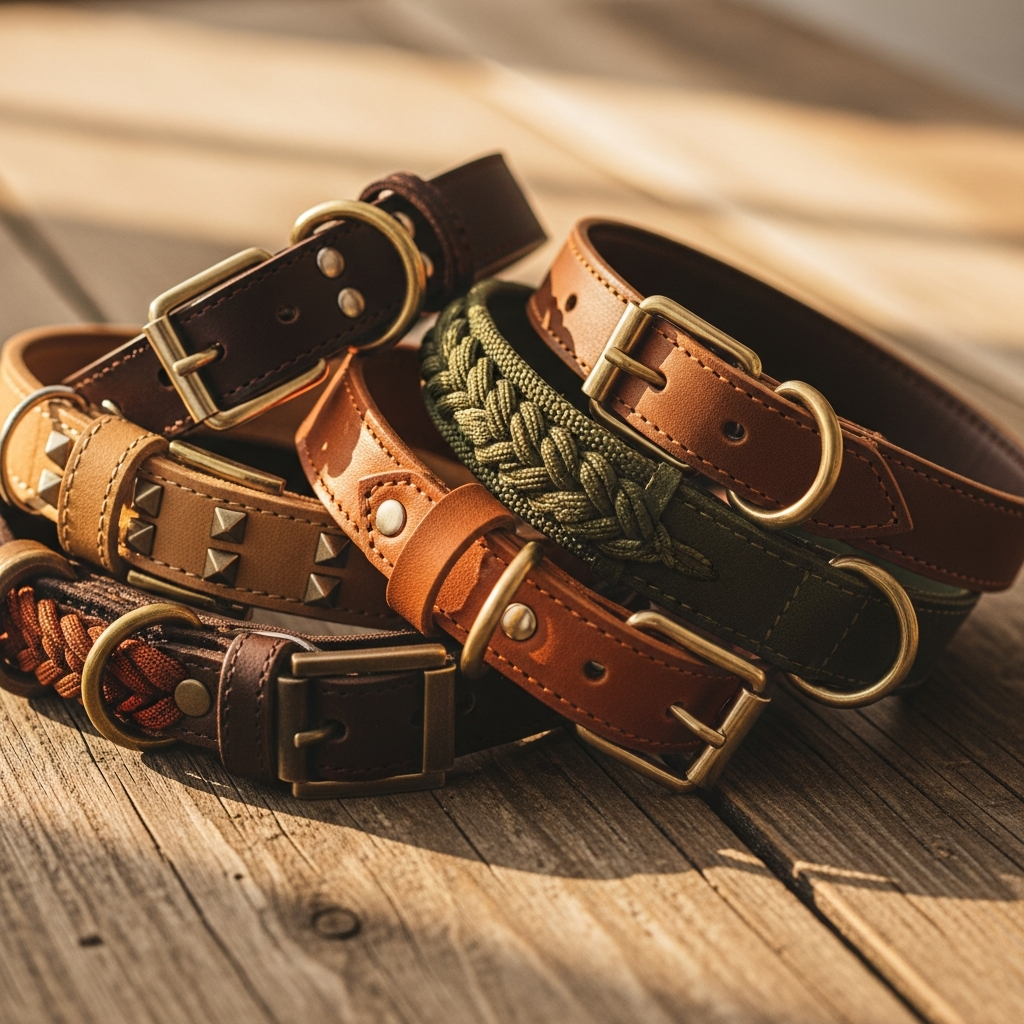
Walk into any pet store and you’ll face a wall of collars in every color, material, pattern, and closure type imaginable. It looks like a fashion decision. It isn’t. The collar you choose should be based on your dog’s size, neck shape, behavior, and how you plan to use it.
Most dogs need two pieces of equipment: a collar for ID tags and daily wear, and a harness for walks. The collar stays on. The harness goes on for leash time. Understanding this distinction helps you choose the right collar without overcomplicating things.
Types of Dog Collars
Flat Collars
The standard. A strip of nylon or leather with a buckle or quick-release clasp. Every dog should have one — it holds ID tags, rabies tags, and license tags. A flat collar is what identifies your dog if they get loose.
Best for: Everyday wear, ID tag holder, dogs that walk on a harness.
Not ideal for: Walking dogs that pull (pressure goes directly to the trachea), breeds that can slip out of a standard collar (Greyhounds, Whippets, Italian Greyhounds).
Top pick: If Made Adjustable Dog Collar Sturdy hardware, clean design, and available in sizes from extra small to extra large. The buckle is metal, not plastic, which matters for durability. A simple collar that does its job well.
Runner-up: Mighty Paw Leather Collar For owners who prefer leather, this is a quality option that softens with wear and holds up for years. The brass hardware adds strength and looks better as it ages.
Martingale Collars
A martingale has a limited-slip design: when the dog pulls or tries to back out, the collar tightens slightly but stops at a preset limit. It won’t choke the dog, but it will prevent escape.
Best for: Sighthounds (Greyhounds, Whippets, Borzoi) and other breeds with narrow heads that can slip out of flat collars. Also used in training contexts where a slight correction signal is helpful.
Not ideal for: Unsupervised wear. Martingale collars can snag on objects because of the extra loop. Remove them when your dog is in a crate, playing off-leash, or unsupervised.
Top pick: PetSafe Martingale Collar Available in a wide size range with a smooth nylon slide that tightens evenly. The quick-snap buckle makes it easy to get on and off. Affordable and reliable.
Runner-up: Ruffwear Web Reaction Collar A premium martingale with Ruffwear’s signature build quality. The reflective webbing and aluminum hardware are nice upgrades if you’re willing to pay more.
Breakaway Collars
A breakaway collar has a safety buckle that releases under pressure. If the collar snags on a crate wire, fence, or branch, it pops open instead of strangling the dog.
Best for: Dogs that spend time in crates, dogs that play with other dogs (collars can get caught in another dog’s mouth), dogs that roam in areas with snag hazards.
Not ideal for: Leash walking. The breakaway mechanism will release if the dog pulls hard enough, which defeats the purpose.
Top pick: KeepSafe Break-Away Collar This is the one I recommend. It has a dual-buckle system: a breakaway buckle for safety and a standard buckle for leash attachment. The breakaway pops under 10–15 pounds of pressure (enough to prevent strangulation but not so light that it opens accidentally).
GPS and Smart Collars
GPS collars have matured significantly. The current generation combines real-time location tracking, escape alerts, activity monitoring, and health metrics into a collar that looks and feels like a regular collar.
If you’re interested in GPS tracking, I’ve written a full deep-dive with subscription cost comparisons: Best GPS Dog Collar and Tracker in 2026.
Collar Types to Approach With Caution
Choke chains: A metal chain that tightens without limit when the dog pulls. These can cause tracheal damage, neck injuries, and nerve damage. I don’t recommend them.
Prong/pinch collars: Metal prongs press into the dog’s neck when they pull. While some professional trainers use these under specific, controlled conditions, they’re not appropriate for the average dog owner. The risk of injury and the potential for negative behavioral effects outweigh any benefits for most dogs.
Shock collars (e-collars): These deliver an electric stimulus. The debate around e-collars is contentious, and I’m not going to wade into the full argument here. What I will say is that for the vast majority of pet dog training situations, there are effective alternatives that don’t involve pain or discomfort. Start with a no-pull harness and training first.
How to Size a Dog Collar
A poorly sized collar is either a safety hazard (too loose — dog escapes) or a comfort problem (too tight — chafing, restricted breathing).
Measuring
Use a soft measuring tape around the base of your dog’s neck, where a collar naturally sits. Pull it snug but not tight. Note the measurement in inches.
The Two-Finger Rule
When the collar is on, you should be able to slip two fingers between the collar and your dog’s neck. Two fingers, flat — not stacked. This ensures the collar is snug enough to stay on but loose enough to not restrict breathing or cause irritation.
Width Matters
Collar width should be proportional to your dog’s size:
- Small dogs (under 20 lbs): 3/8" to 5/8" width
- Medium dogs (20–50 lbs): 3/4" to 1" width
- Large dogs (50–90 lbs): 1" to 1.5" width
- Giant breeds (90+ lbs): 1.5" to 2" width
A collar that’s too wide can be uncomfortable and restrict neck movement. A collar that’s too narrow can dig in and create pressure points.
Puppy Sizing
Puppies grow fast. Check the collar fit weekly and adjust or replace as needed. A collar that fit perfectly at 10 weeks may be dangerously tight by 14 weeks. Many owners find adjustable collars with a wide range helpful during the growth phase.
Collar Materials: What to Choose
Nylon
Pros: Affordable, available in every color and pattern, lightweight, easy to clean, quick-drying. Cons: Can fray over time, may cause chafing on dogs with sensitive skin, the hardware (buckles, D-rings) is more important than the webbing itself.
Best for: Most dogs, everyday use, owners who like variety.
Leather
Pros: Durable, softens with wear, gentle on the neck, looks better with age, won’t fray. Cons: More expensive, requires occasional conditioning, not ideal for water dogs (can deteriorate with repeated soaking).
Best for: Dogs with sensitive skin, owners who prefer a classic look, dogs that wear a collar full-time.
Biothane
Pros: Waterproof, virtually indestructible, easy to clean (just wipe), doesn’t hold odor, available in bright colors. Cons: More expensive than nylon, limited pattern options, can feel stiff when new.
Best for: Dogs that swim frequently, muddy outdoor dogs, hunting dogs, any dog that gets wet and dirty regularly.
Chain
Pros: Extremely durable, useful for dogs that chew through other materials. Cons: Heavy, can pull on fur, cold in winter, noisy.
Best for: Dogs that destroy nylon and leather collars. Not my first choice, but sometimes it’s the only collar that survives.
Collar vs. Harness: When to Use Each
This question comes up constantly, so let me be clear:
Use a collar for:
- Holding ID tags (always)
- Quick bathroom breaks in a fenced yard
- Around the house (if your dog tolerates it)
Use a harness for:
- All leash walks
- Any dog that pulls (collar walking a pulling dog risks tracheal damage)
- Brachycephalic breeds (Pugs, Bulldogs, French Bulldogs) — their airways are already compromised
- Small dogs — their necks are delicate
Use both: Collar stays on for ID. Harness goes on for walks, with the leash clipped to the harness. This is the setup I recommend for virtually every dog.
Read our full harness guide: Best No-Pull Dog Harness. Pair with the right leash: Best Dog Leash.
Collar Safety Tips
- Never leave a collar on an unsupervised dog in a crate. Collars can catch on crate wires. Use a breakaway collar or remove the collar entirely.
- Check the fit monthly. Weight changes, fur growth, and general wear can change how a collar fits.
- Replace frayed or damaged collars immediately. A collar that breaks when your dog is loose near a road is not a situation you want.
- Use a collar with a visible ID tag even if your dog is microchipped. A tag provides instant identification. A microchip requires a scanner. Both together provide the best protection.
- Reflective trim or a light-up collar is worth considering if you walk in low-light conditions.
Frequently Asked Questions
What’s the best collar for a puppy?
A basic adjustable nylon flat collar is all a puppy needs. Don’t spend a lot — you’ll replace it several times as the puppy grows. Make sure it has a quick-release buckle for safety and check the fit weekly.
Should my dog wear a collar all the time?
During the day when supervised, yes — it holds ID tags. Remove it at night, during crate time, and during unsupervised play. If you want 24/7 wear, use a breakaway collar.
My dog keeps slipping out of their collar. What do I do?
Switch to a martingale collar. The limited-slip design prevents escape without choking. This is especially common in sighthounds and dogs with narrow heads relative to their neck size.
Are personalized/embroidered collars worth it?
Embroidered collars with your dog’s name and your phone number are a great backup to a tag. Tags can fall off. An embroidered collar can’t. I recommend using both an embroidered collar and a tag for maximum identification.
How do I clean a dog collar?
Nylon: Hand wash with mild soap and warm water, air dry. Machine washing is fine occasionally but can wear out the webbing faster. Leather: Wipe with a damp cloth and condition with leather conditioner every few months. Biothane: Wipe with a wet cloth. That’s it.
What’s the difference between a buckle collar and a quick-release collar?
A buckle collar uses a traditional pin-through-hole closure (like a belt). It’s more secure but takes longer to put on. A quick-release collar uses a plastic or metal snap buckle that clicks together. It’s faster but slightly less secure. For most dogs, quick-release is fine. For very large or very strong dogs, a buckle closure is more reliable.
Prices last updated February 2026. We use affiliate links — if you purchase through our links, we may earn a commission at no extra cost to you.
Back to the Dog Gear hub for more tested recommendations.