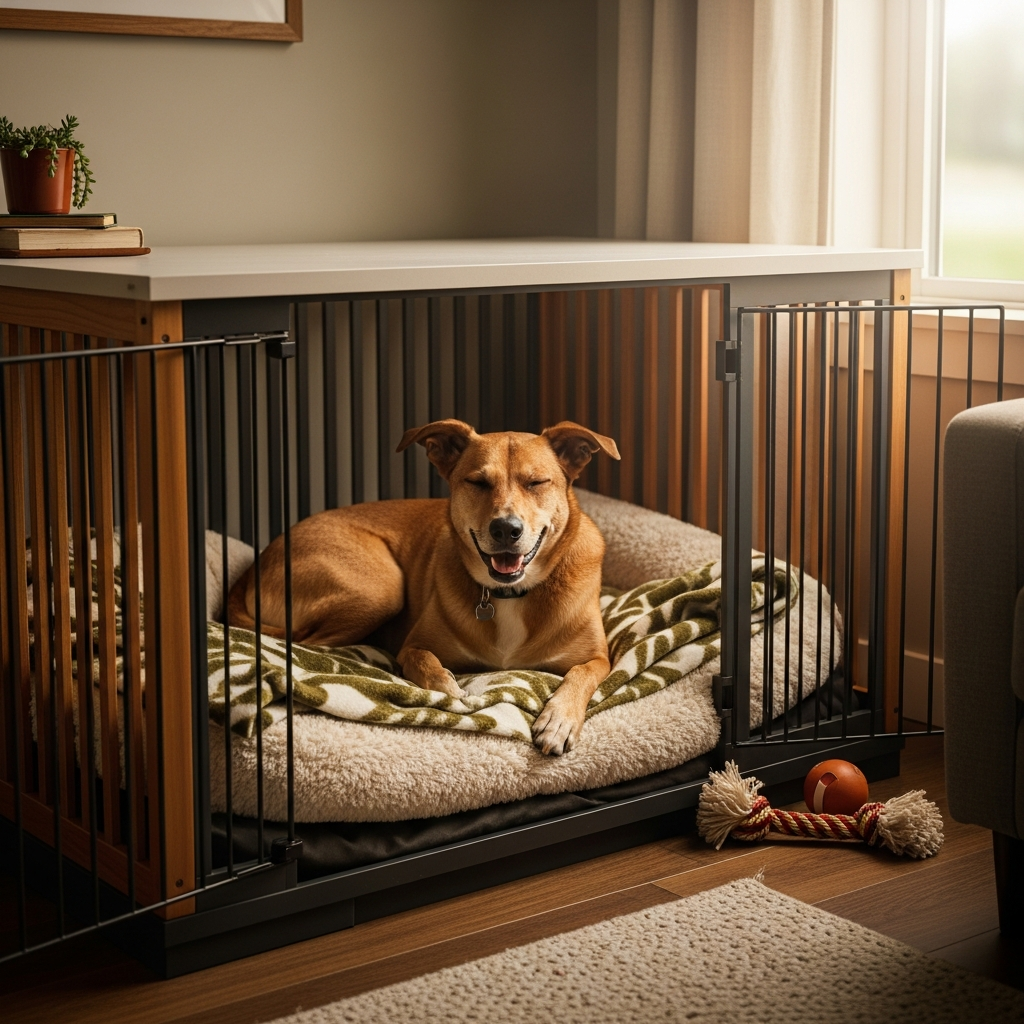
A crate, used correctly, is your dog’s safe space. It’s their den — a place to retreat, relax, and feel secure. Used incorrectly, it’s a cage that creates stress and behavioral problems. The difference comes down to choosing the right crate, sizing it properly, and introducing it the right way.
This guide covers the gear side: which crate to buy, what size you need, and how to set it up. For the training side — how to teach your dog to love the crate — see our crate training guide.
If you’re bringing home a new puppy, the crate is one of the first things you need. Check our new puppy checklist for the complete first-purchase list.
Types of Dog Crates
Wire Crates
The most versatile and popular option. A wire crate is essentially a metal frame with wire panels, a removable plastic tray on the bottom, and one or two doors.
Pros:
- Maximum ventilation and visibility
- Most models fold flat for storage and transport
- Removable tray makes cleaning easy
- Many include a divider panel (essential for growing puppies)
- Dogs can see out in all directions, which reduces claustrophobia
Cons:
- Not airline-approved for cargo travel
- Can be noisy — dogs can rattle the wire panels
- Not ideal for anxious dogs that prefer an enclosed space (though draping a cover helps)
- Sharp wire edges on cheap models can be a safety issue
Best for: General home use, puppies (with divider), dogs that don’t have crate anxiety, owners who want easy cleanup and portability.
Plastic Crates (Airline-Style)
A solid plastic shell with a wire door and ventilation slots on the sides. This is the type most airlines require for cargo travel.
Pros:
- More enclosed, den-like feel that many dogs prefer
- Airline-approved models available (check specific airline requirements)
- Quieter than wire crates
- Easier to keep warm in cold climates
- Generally lighter than wire crates of the same size
Cons:
- Less ventilation (can get warm in hot weather)
- Limited visibility for the dog
- Don’t fold down — storage takes more space
- Harder to clean (no removable tray)
- The bolts connecting the top and bottom halves can loosen over time
Best for: Air travel, dogs that prefer enclosed spaces, anxious dogs that feel calmer in a den-like environment, car travel (more contained than wire in case of accident).
Furniture-Style Crates
A crate designed to look like a piece of furniture — typically an end table, cabinet, or credenza. The crate function is built into a wooden or composite frame with ventilation panels.
Pros:
- Blends into your living space (looks like furniture, not a cage)
- Solid construction feels permanent and stable
- The flat top surface doubles as a table
- Many dogs like the enclosed, furniture-like feel
Cons:
- Expensive ($150–$400+)
- Heavy and not portable
- Not suitable for puppies (they’ll chew the wood)
- Less ventilation than wire crates
- Difficult to clean compared to wire or plastic
- Not appropriate for dogs that are destructive in crates
Best for: Adult dogs that are already crate-trained, living rooms where a wire crate would be an eyesore, owners willing to invest in aesthetics.
Soft-Sided Crates
A collapsible frame with fabric panels. Lightweight and extremely portable.
Pros:
- Lightest option available
- Folds completely flat for storage and travel
- Comfortable for dogs (soft fabric, mesh windows)
- Great for car travel and outdoor events
Cons:
- Zero security for dogs that chew, dig, or try to escape
- Not suitable for puppies
- Fabric holds odor and is harder to clean
- Flimsy compared to wire or plastic
- A determined dog can tear through the fabric in seconds
Best for: Well-trained adult dogs, travel crate for calm dogs, dog shows and outdoor events, as a secondary crate for trips.
Heavy-Duty Crates
Steel or aluminum construction designed for dogs that break out of standard crates. Impact, Gunner, and ProSelect are the main players in this space.
Pros:
- Virtually escape-proof for all but the most extreme cases
- Designed for dogs with severe separation anxiety that destroy wire crates
- Crash-tested options available (Gunner Kennels)
- Built to last indefinitely
Cons:
- Expensive ($200–$700+)
- Heavy (some weigh 50+ pounds)
- Limited sizes and configurations
- Overkill for most dogs
Best for: Dogs that have escaped wire or plastic crates, dogs with severe separation anxiety, vehicle crates where crash protection matters.
How to Size a Dog Crate
Crate size is the most important decision, and it’s where most people go wrong — usually by buying too large.
The Golden Rule
Your dog should be able to:
- Stand up without their head touching the top
- Turn around in a full circle without bumping the sides
- Lie down fully stretched with a few inches of clearance
That’s it. The crate should not be much bigger than this. A crate that’s too large defeats the purpose: dogs are less likely to feel the den-like security, and puppies will use one end as a bathroom and the other as a bedroom (which sabotages house training).
Measuring Your Dog
- Height: Measure from the floor to the top of the head (or ear tips if the ears stand up). Add 2–4 inches.
- Length: Measure from the nose to the base of the tail. Add 2–4 inches.
- Those measurements are your minimum crate interior dimensions.
Crate Size Chart
| Dog size | Weight range | Recommended crate | Example breeds |
|---|---|---|---|
| XS | Under 10 lbs | 18"–22" | Chihuahua, Yorkie, Papillon |
| Small | 10–25 lbs | 24"–30" | Dachshund, Shih Tzu, Pug |
| Medium | 25–50 lbs | 30"–36" | Beagle, Cocker Spaniel, Corgi |
| Large | 50–80 lbs | 36"–42" | Labrador, Golden Retriever, Boxer |
| XL | 80–100 lbs | 42"–48" | German Shepherd, Rottweiler, Doberman |
| XXL | 100+ lbs | 48"–54" | Great Dane, Mastiff, Saint Bernard |
Puppy Sizing
Don’t buy a puppy-sized crate — buy an adult-sized crate with a divider. The divider lets you section off part of the crate, giving the puppy only the space they need right now. As the puppy grows, move the divider back. Most wire crates include a divider. If yours doesn’t, buy one separately.
Best Dog Crates by Category
Best Wire Crate: MidWest Ultima Pro Double Door
Price: $45–$100 (depending on size) | Sizes: 24" to 48"
MidWest makes the most popular wire crates on the market, and the Ultima Pro is their best model. It’s sturdier than their iCrate line, with thicker gauge wire, stronger latches, and a more durable plastic pan.
What I like:
- Double doors (front and side) for flexible placement in your home
- Includes a divider panel for puppies
- Folds flat with a carrying handle
- The removable plastic pan slides out for easy cleaning
- The wire gauge is noticeably thicker than budget crates
What I don’t:
- Slightly heavier than the standard iCrate due to the thicker wire
- The slide-bolt latches can be figured out by smart dogs (though it takes effort)
- Large sizes are heavy when assembled
Best for: Most dogs, most situations. This is the default recommendation for a reason.
Best Plastic Crate: Petmate Sky Kennel
Price: $50–$120 | Sizes: 21" to 48" | Airline approved: Yes (check specific airline requirements)
If you need an airline-approved crate or your dog prefers an enclosed space, the Sky Kennel is the standard. It meets IATA requirements for air travel and provides the enclosed, den-like environment that many dogs find calming.
What I like:
- IATA-compliant for most airlines (always verify with your specific airline)
- The ventilation slots are positioned for good airflow without too much visibility
- The steel wire door is more secure than the plastic doors on cheaper models
- Sturdy construction that handles airport baggage handling
- “Live Animal” stickers and cable ties are included
What I don’t:
- Doesn’t fold down. Stores as a two-piece shell (top lifts off bottom), but still takes up space.
- The bolt system connecting the halves can loosen — check before every trip
- Less ventilation than wire crates. Don’t use in hot environments without air conditioning.
Best for: Air travel, car travel, dogs that prefer enclosed spaces, anxious dogs.
Best Furniture Crate: New Age Pet ecoFLEX Crate
Price: $100–$200 | Sizes: S to XL
The ecoFLEX is made from a composite material that looks like wood but doesn’t absorb moisture, stain, or warp. It’s the most practical furniture-style crate I’ve tested because it addresses the biggest problem with wooden crates: dogs sweat, drool, and have accidents, and real wood absorbs all of it.
What I like:
- The ecoFLEX material resists moisture, stain, and odor
- Looks genuinely like a piece of furniture (doubles as an end table)
- The door latch is secure but easy for humans to operate
- Stainless steel spindle bars instead of wire mesh (cleaner look, stronger)
- Available in espresso and russet colors that blend with most furniture
What I don’t:
- Not suitable for chewers or escape artists. This is for crate-trained dogs only.
- The ventilation is limited compared to wire crates
- Assembly required, and the instructions are mediocre
- The price premium is entirely for aesthetics
Best for: Crate-trained adult dogs, living rooms and bedrooms where aesthetics matter, owners who want the crate to blend in.
Best Heavy-Duty Crate: Impact Dog Crate High Anxiety
Price: $350–$600 | Sizes: 28" to 48" | Material: Aluminum
This is the crate you buy when your dog has destroyed every other crate you’ve tried. The all-aluminum construction with rounded corners and slam latches is designed for dogs with severe crate anxiety or escape tendencies. It’s expensive, but for dogs that bend wire crate bars or shatter plastic crates, it’s the only solution that works.
What I like:
- Escape-proof for all but the most extreme cases
- Rounded interior corners eliminate injury risk (a real concern with bent wire crates)
- Slam latches can’t be manipulated by the dog
- Aluminum doesn’t rust, dent, or corrode
- Easy to clean with a hose
What I don’t:
- Very expensive
- Heavy
- If your dog has this level of crate anxiety, the crate alone isn’t the solution — you need professional behavioral help alongside it
Best for: Dogs with severe separation anxiety, dogs that have escaped or damaged other crates, situations where escape is dangerous (thunderstorms, fireworks).
How to Set Up a Dog Crate
Location
Place the crate in a common area where your family spends time. Dogs are social animals — they want to be near their people, even when resting. The living room or a corner of the kitchen are common choices. Avoid basements, garages, or isolated rooms.
For nighttime, many owners keep a second crate in the bedroom, or move the crate there at night. Especially for puppies, being near you at night reduces whining and speeds up crate training.
Bedding
A crate pad or mat makes the crate more comfortable and inviting. For puppies that are still being house trained, use a waterproof, washable pad rather than an expensive bed (accidents will happen). For adult dogs, a quality crate pad or a fitted orthopedic mat can turn the crate into a genuinely comfortable sleep space.
Important: Don’t put bedding in the crate of a puppy or dog that chews fabric unsupervised. Ingesting fabric is a choking and intestinal blockage risk.
Accessories
- Water bowl: For long crate stays (more than 2 hours), attach a no-spill water bowl to the inside of the crate door.
- Safe chew toy: A Kong or similar durable toy gives your dog something to do. Avoid toys with small parts that could be swallowed.
- Crate cover: Draping a blanket or fitted cover over a wire crate creates a den-like feel that many dogs find calming. Leave the front uncovered for airflow.
What Not to Put in the Crate
- Collars (strangulation risk — the collar can snag on the wire). Use a breakaway collar if your dog must wear one.
- Harnesses (same snagging risk)
- Stuffed toys with button eyes or squeakers (swallowing hazard when unsupervised)
- Rawhides or bones that can splinter
Crate Training Basics
The crate is a tool. How you introduce it determines whether your dog views it as a refuge or a punishment.
The short version: never force your dog into the crate. Use treats, meals, and positive association to make the crate a place your dog chooses to enter. Start with the door open. Build up duration gradually. Never use the crate as punishment.
For the complete step-by-step process, read our crate training guide. It covers everything from the first introduction to overnight stays.
How Long Can a Dog Stay in a Crate?
General guidelines:
| Age | Maximum crate time |
|---|---|
| 8–10 weeks | 1 hour |
| 11–14 weeks | 1–3 hours |
| 15–16 weeks | 3–4 hours |
| 17+ weeks | 4–5 hours |
| Adult dogs | 6–8 hours (with appropriate exercise before and after) |
These are maximums, not goals. Less time is always better. A dog that spends 8 hours in a crate while you’re at work and then 8 hours in a crate overnight is spending 16 hours a day confined. That’s too much for any dog.
If your work schedule requires extended crate time, arrange for a midday dog walker or consider a larger exercise pen (x-pen) instead.
Frequently Asked Questions
Is crate training cruel?
No, when done correctly. Dogs are den animals by nature — they seek small, enclosed spaces when they feel stressed or want to rest. A properly introduced crate becomes a place your dog voluntarily chooses to go. The problem isn’t the crate itself; it’s misuse: forcing a dog in, using it as punishment, or leaving a dog confined for excessive periods.
My dog whines in the crate. What do I do?
Don’t let them out while they’re whining (this teaches them that whining opens the door). Wait for even a brief pause in the whining, then open the door. Also consider: is the crate the right size? Is the dog getting enough exercise before crate time? Has the dog been properly introduced to the crate? Our crate training guide covers troubleshooting in detail.
Should I cover the crate?
Many dogs prefer a covered crate — it creates a darker, more enclosed den feel. Try draping a blanket over the top and sides while leaving the front open. If your dog seems calmer and sleeps better, keep the cover. If they seem stressed by reduced visibility, remove it.
Wire or plastic — which is better?
For most home use, wire is better: more ventilation, easier to clean, folds for storage. For travel, anxious dogs, or dogs that prefer enclosed spaces, plastic is better. There’s no universal answer — match the crate to your dog’s needs and your situation.
Can I use a crate for an adult dog that’s never been crate trained?
Yes, but the introduction process takes longer with adult dogs. Follow the same gradual, positive approach described in our crate training guide. Adult dogs can absolutely learn to love a crate; it just requires patience.
When should I stop using a crate?
Some dogs love their crate for life and choose to sleep in it with the door open. Others can be transitioned to free roaming once they’re reliably house trained and no longer destructive when unsupervised. Most dogs reach this point between 1–2 years of age, though it varies. Keep the crate available even after you stop requiring its use — many dogs return to it voluntarily.
Prices last updated February 2026. We use affiliate links — if you purchase through our links, we may earn a commission at no extra cost to you.
Back to the Dog Gear hub for more tested recommendations.