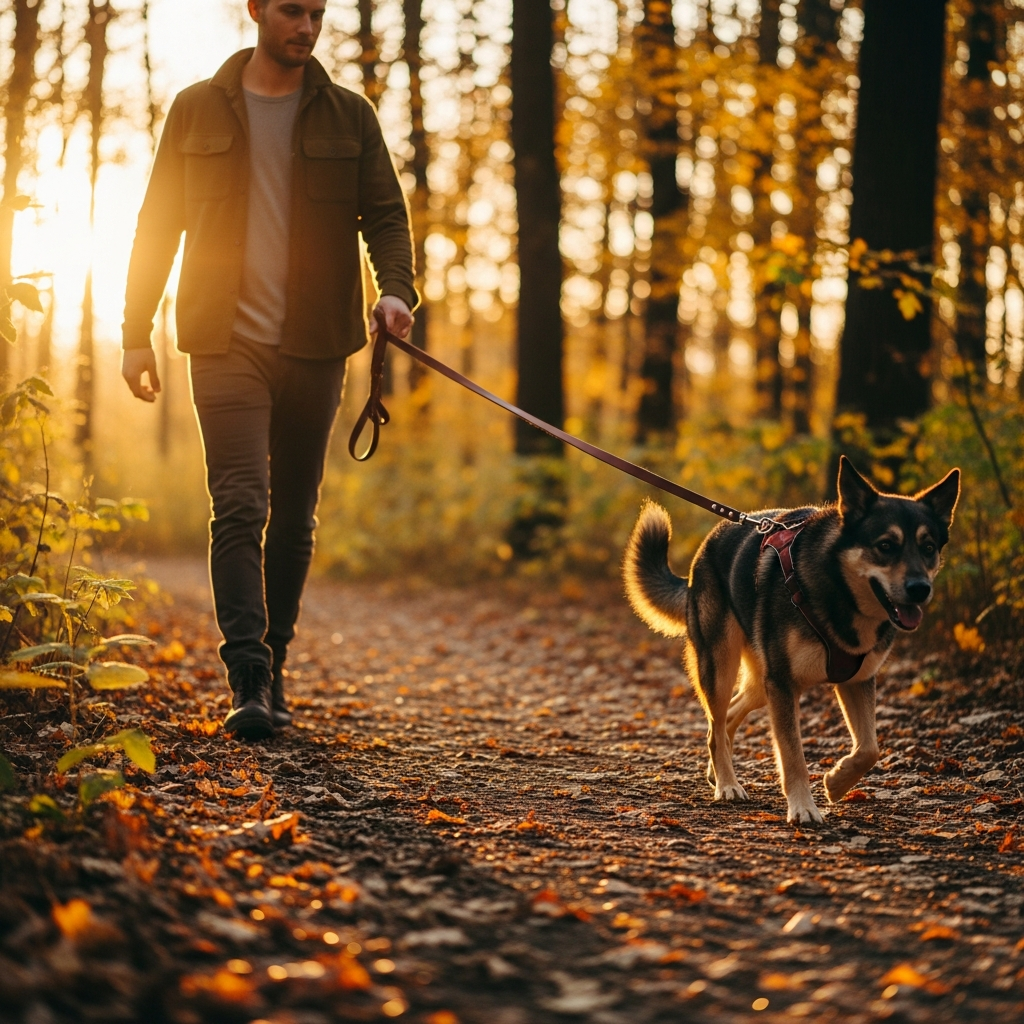
A leash seems like the simplest piece of dog gear you’ll buy. Strap, clasp, handle. Done. But the wrong leash for your situation creates problems you don’t expect — tangled legs, rope burns, broken clasps, zero control when you need it most.
I’ve used every type of leash across years of daily walks, trail hikes, and training sessions. Here’s what actually works, what doesn’t, and which leash you should buy based on how you actually spend time with your dog.
Types of Dog Leashes
Standard Leash (6-Foot)
The workhorse. A six-foot flat leash in nylon, leather, or biothane with a bolt snap clasp. This is the leash you’ll use 90% of the time, and it’s the one every dog owner should own.
Six feet gives your dog enough slack to sniff and explore without being so far away that you lose control. It’s the length required by most leash laws and the length recommended by virtually every professional trainer.
When to use it: Daily walks, neighborhood strolls, vet visits, anywhere with other people and dogs.
Long Line (15–50 Feet)
A long line is a training tool, not a walking leash. It gives your dog freedom to roam at distance while you maintain an emergency connection. It’s essential for recall training because it lets you practice “come” at realistic distances without risking your dog running off.
When to use it: Recall training, beach visits, open fields, parks where off-leash isn’t allowed but your dog needs room to run.
When not to use it: Sidewalks, crowded areas, anywhere near traffic. A 30-foot leash near a road is asking for trouble.
Retractable Leash
Here’s where I’ll be honest: retractable leashes get a bad reputation, and much of it is deserved. But they’re not universally terrible — they’re situationally appropriate.
A retractable leash has a spring-loaded mechanism inside a plastic handle that lets the line extend and retract. The dog gets more freedom, and you can lock the line at any length.
The problems:
- The thin cord or tape can snap under sudden force from a large dog
- The cord can cause severe rope burns on hands and legs if a dog bolts
- The locking mechanism can fail, especially on cheaper models
- The constant tension teaches dogs to pull (the leash always has resistance, so the dog learns to lean into it)
- The length makes it nearly impossible to control a dog quickly in an emergency
When they’re acceptable: For well-trained dogs in open, low-traffic areas. For elderly owners who want to give their dog some freedom without walking far. For small dogs that pose minimal risk if the mechanism fails.
When they’re not: Near roads, near other dogs, for dogs that pull, for large or strong dogs, for any dog whose recall isn’t reliable.
If you do use a retractable, buy one with a flat tape (not cord) from a reputable brand like Flexi. The flat tape is stronger, less likely to cut, and more visible.
Hands-Free Leash
A hands-free leash clips around your waist or across your body, freeing your hands for running, hiking, pushing a stroller, or just carrying things. They typically include a bungee section that absorbs shock from sudden pulling.
When to use it: Running or jogging with your dog, hiking, walking with a stroller, any activity where free hands are important.
When not to use it: With dogs that lunge unpredictably (a waist-attached lunging dog can knock you off your feet), with untrained puppies, or in situations requiring precise control.
Traffic Leash (Short Lead)
A short leash, typically 12–18 inches, designed for situations where your dog needs to be right at your side. Walking through crowds, crossing busy streets, or moving through tight spaces.
When to use it: Veterinary clinics, busy sidewalks, pet store visits, anywhere you need your dog within arm’s reach.
Best Dog Leashes by Type
Best Standard Leash: Max and Neo Double Handle Leash
Price: $15–$20 | Length: 6 feet | Material: Nylon
This leash has a feature that should be standard on every leash but somehow isn’t: a second handle near the clasp. The main handle gives you standard six-foot control. The secondary handle, located about 18 inches from the clasp, gives you immediate close control when you need to pull your dog in quickly.
What I like:
- Dual-handle design is genuinely useful every single day
- Heavy-duty clasp that hasn’t loosened or failed in extended testing
- Reflective stitching for low-light visibility
- The nylon is padded at the handles, which matters on long walks
What I don’t:
- The secondary handle can flop around when not in use. Minor annoyance.
- Only available in a few colors. Not a real problem, but worth noting.
Best Leather Leash: Coastal Pet Latigo Leather Leash
Price: $20–$30 | Length: 6 feet | Material: Latigo leather
Leather leashes get better with age. This Coastal Pet leash starts slightly stiff and breaks in to become the most comfortable leash you’ll ever hold. No hand fatigue, no rope burn, no nylon edge digging into your palm.
What I like:
- Latigo leather is pre-conditioned and breaks in quickly
- Brass hardware is strong and corrosion-resistant
- Gets more comfortable with every use
- Will last 5–10 years with minimal care
What I don’t:
- Not ideal for dogs that swim regularly (water degrades leather over time)
- More expensive than nylon alternatives
- Requires occasional conditioning
Best Long Line: Mendota Products Check Cord
Price: $15–$25 | Length: 15, 20, 30, or 50 feet | Material: Polypropylene
The Mendota check cord is the standard training long line for a reason. It’s lightweight, doesn’t absorb water, and the polypropylene material slides through grass without tangling.
What I like:
- Lightweight enough that your dog barely notices the drag
- Waterproof — won’t get heavy or mildewy when wet
- The bright colors are easy to see (important when there’s 30 feet of line on the ground)
- Affordable enough that you can buy two lengths
What I don’t:
- The snap clasp is adequate but not heavy-duty. For dogs over 60 pounds, consider upgrading the clasp.
- Polypropylene can cause rope burn if it slides through your hands quickly. Wear gloves for large dogs.
Best Hands-Free Leash: Tuff Mutt Hands-Free Bungee Leash
Price: $25–$30 | Material: Nylon with bungee section
The Tuff Mutt has a dual-handle system (waist belt plus a hand-held handle section) and a bungee extension that absorbs the shock of sudden pulls. It’s my pick for runners and hikers.
What I like:
- The bungee section genuinely absorbs pull shock — your hips will thank you
- The waist belt is padded and adjustable (fits up to 42" waist)
- Includes both waist and hand-held options in one leash
- The reflective stitching is visible and well-placed
What I don’t:
- The bungee adds bounce during normal walking, which some dogs find confusing at first
- Not enough control for reactive dogs or dogs in active training
- The waist belt can shift if not tightened properly
Best Retractable Leash: Flexi New Classic Tape
Price: $15–$25 | Length: 16 or 26 feet | Material: Flat tape
If you’re going to use a retractable, this is the one. Flexi essentially invented the category, and the New Classic with flat tape is their most reliable model.
What I like:
- Flat tape instead of cord (stronger, less cutting risk, more visible)
- Smooth retraction mechanism that rarely jams
- The brake button is responsive and locks firmly
- Available in size ratings from small to large (match to your dog’s weight)
What I don’t:
- It’s still a retractable leash, with all the inherent limitations I described above
- The plastic handle can crack if dropped on hard surfaces
- For dogs over 60 pounds, I still recommend a standard leash instead
Leash Hardware: What to Look For
The clasp matters more than the leash itself. A leash is only as strong as its weakest point, and that’s almost always the clasp.
Bolt snap: The most common type. A spring-loaded hook that clips to the D-ring. Reliable for most dogs. Can fail under extreme sudden force on cheap models.
Trigger snap: A larger, sturdier version of the bolt snap. Better for large and strong dogs. Easier to clip and unclip with cold or wet hands.
Carabiner-style: An oversized climbing-style clip. Extremely secure, virtually impossible for a dog to shake loose. The best option for large, powerful dogs. Slightly harder to clip one-handed.
Avoid: Lobster-claw clasps on light-duty leashes (they bend under force), and any clasp made entirely of plastic.
Pairing Your Leash With the Right Gear
A leash works best as part of a system:
- Leash + front-clip harness = the best setup for dogs that pull. The harness redirects, the leash controls distance. See our no-pull harness guide.
- Leash + flat collar = fine for well-trained dogs that don’t pull. Not recommended for pullers (risk of tracheal damage).
- Leash + martingale collar = good for sighthounds and escape-prone dogs. See our collar guide.
- Long line + harness = the ideal training setup for recall work. Never use a long line attached to a collar — a sudden stop from 30 feet away puts dangerous force on the neck.
Leash Etiquette and Safety
A few rules that make walks better for everyone:
- Keep your dog on your side of the sidewalk when passing other people and dogs.
- Shorten the leash when passing other dogs. Even friendly dogs can have unexpected reactions.
- Don’t wrap the leash around your hand. If your dog bolts, a wrapped leash can break fingers. Hold the handle loop with a relaxed grip.
- Replace leashes that show wear. Frayed nylon, cracked leather, and bent clasps are failure points waiting to happen.
- Don’t use two leashes on one dog (one on collar, one on harness). It tangles, confuses the dog, and eliminates the mechanical advantage of the harness.
Frequently Asked Questions
What length leash is best for walking?
Six feet. It’s the standard for a reason: enough freedom for your dog to sniff and explore without being so far away that you lose control. Most leash laws specify six feet or shorter.
Are leather leashes better than nylon?
Neither is objectively better — they’re different. Leather is more comfortable in the hand, lasts longer, and gets better with age, but costs more and shouldn’t get repeatedly wet. Nylon is affordable, durable, quick-drying, and available in every color. Choose based on your dog’s lifestyle.
Should I use a retractable leash?
Only if your dog is well-trained, you’re in an open area away from traffic and other dogs, and you understand the risks. For most situations, a standard six-foot leash is safer and more practical.
My dog chews through leashes. What do I do?
Try a chain leash or a cable-reinforced leash. Also address the chewing behavior — it’s usually a sign of anxiety, boredom, or frustration. In the meantime, a bitter apple spray on the leash can deter chewing.
What’s a traffic handle?
A secondary loop or handle located near the clasp end of the leash. It gives you instant close control of your dog without reeling in six feet of leash. Essential for crossing streets, passing other dogs, and navigating tight spaces.
How do I stop my leash from tangling?
Most tangling happens with retractable leashes and long lines. For standard leashes, loop the excess in your hand rather than letting it drag. For long lines, let the line trail on the ground behind the dog rather than trying to hold all of it. The Mendota check cord’s slick polypropylene is specifically designed to resist tangling.
Prices last updated February 2026. We use affiliate links — if you purchase through our links, we may earn a commission at no extra cost to you.
Back to the Dog Gear hub for more tested recommendations.