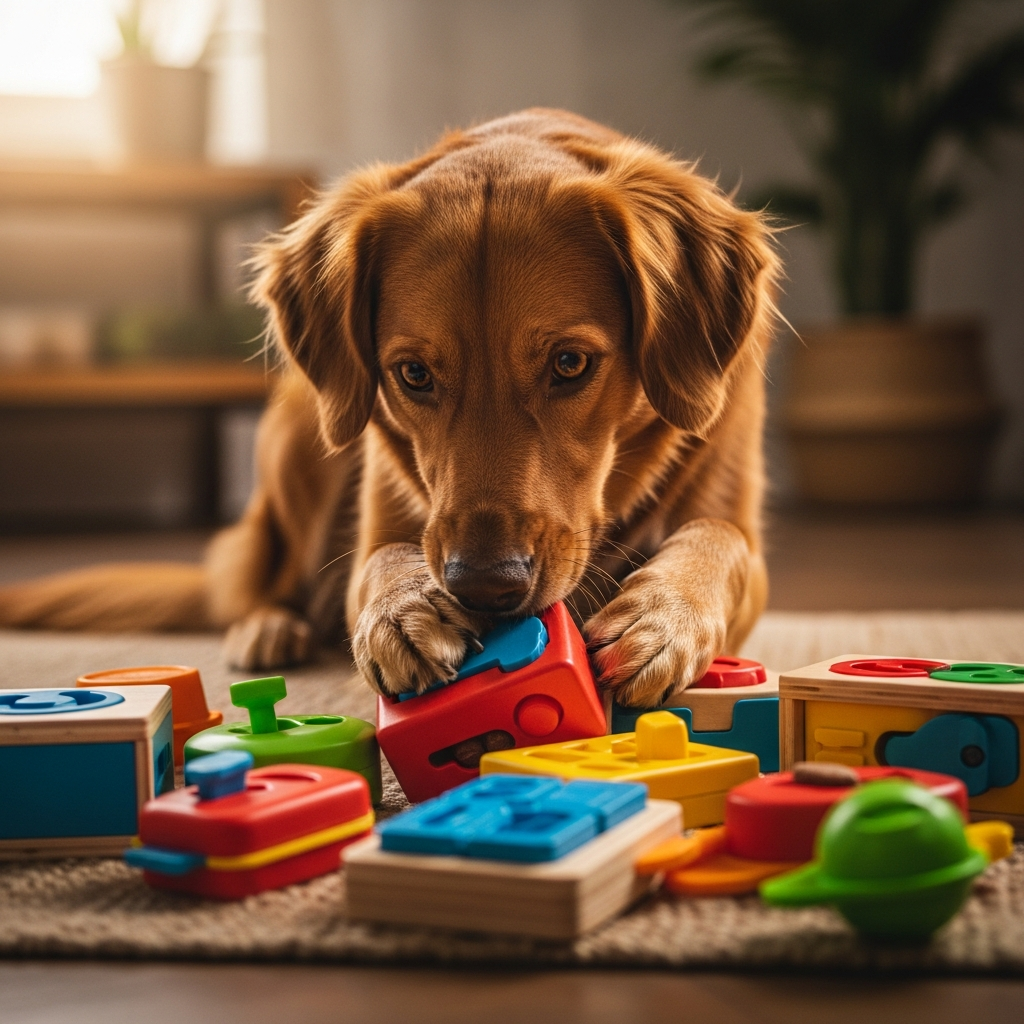
A bored dog is a destructive dog. That’s not a character flaw — it’s biology. Dogs are problem-solvers by nature. When they don’t have problems to solve, they invent their own: shredded pillows, excavated gardens, remodeled baseboards. Interactive toys give your dog’s brain a job, and a mentally tired dog is just as satisfied as a physically tired one.
I’ve tested puzzle feeders, Kongs, snuffle mats, lick mats, and various “smart” toys across multiple dog sizes and intelligence levels. Some are brilliant. Some fall apart after one session. Some are so easy that my dog solves them in 30 seconds and looks at me with disappointment. Here’s what actually works.
If your dog’s destructive behavior goes beyond boredom into anxiety territory, also read our dog anxiety guide. And for a broader approach to keeping your dog’s brain active, check out our guide on mental enrichment for dogs.
Types of Interactive Dog Toys
Puzzle Feeders
These are toys or boards with compartments, sliders, drawers, and covers that hide treats. The dog has to figure out how to manipulate the toy to access the food. Difficulty ranges from “push the flap” to “solve a multi-step sequence.”
Best for: Mealtime enrichment, dogs that eat too fast, high-intelligence breeds that need mental challenges.
Stuffable Toys (Kong-Style)
Hollow toys that you fill with treats, peanut butter, kibble, or a combination. The dog works to extract the food by licking, chewing, and manipulating the toy. The classic Kong is the most well-known, but several quality alternatives exist.
Best for: Crate time, separation anxiety management, keeping dogs occupied during work calls, freezable for longer-lasting engagement.
Snuffle Mats
Fabric mats with long, floppy strips that hide treats between the fibers. The dog uses their nose to root through the fabric and find the food. It mimics the natural foraging behavior dogs evolved with.
Best for: Nose work, slowing down fast eaters, calm enrichment (not a high-energy activity), dogs of all ages.
Lick Mats
Flat silicone mats with textured surfaces where you spread soft foods (peanut butter, yogurt, wet dog food, pumpkin puree). The dog licks the food off the textured surface, which takes significantly longer than eating from a bowl.
Best for: Calming anxious dogs (licking releases endorphins), bath time distraction, meal slowing, grooming distraction.
Treat-Dispensing Balls and Toys
Toys with adjustable openings that release kibble or small treats as the dog rolls, pushes, or manipulates them. The food comes out unpredictably, keeping the dog engaged.
Best for: Active dogs that need physical and mental stimulation combined, feeding meals in a more engaging way, dogs that are home alone.
Best Interactive Dog Toys Ranked
1. Kong Classic — Best Overall Interactive Toy
Price: $8–$15 | Sizes: XS to XXL | Difficulty: Variable (easy to hard depending on stuffing)
The Kong Classic has been the gold standard for stuffable toys for decades, and nothing has truly replaced it. The natural rubber is durable enough for aggressive chewers (the black “Extreme” version is even tougher), the shape bounces unpredictably, and the stuffing possibilities are virtually limitless.
What I like:
- Nearly indestructible for most dogs (the Extreme version handles power chewers)
- Freezable — pack with peanut butter and kibble, freeze overnight, and you have 30–60 minutes of engagement
- The irregular shape makes it bounce unpredictably when thrown
- Dishwasher safe
- Available in puppy, standard, and extreme rubber formulas
What I don’t:
- By itself, it’s easy. The magic is in how you stuff it. A hollow Kong with a few treats falls out immediately. A packed, frozen Kong is an entirely different challenge.
- The rubber can stain light-colored carpets when wet
- Dogs that have mastered the Kong may need to move on to harder puzzles
Stuffing ideas (from easy to hard):
- Loose kibble (easy — falls right out)
- Kibble with peanut butter plug at the top (medium)
- Layered: wet food, kibble, banana, peanut butter cap, frozen (hard)
- Broth-soaked kibble, frozen solid (hard — takes 30–60 minutes)
Best for: Every dog. This is the one interactive toy I recommend every dog owner buy.
2. Nina Ottosson Dog Tornado — Best Puzzle Feeder
Price: $15–$25 | Sizes: One size | Difficulty: Level 2 (intermediate)
Nina Ottosson makes the best puzzle feeders on the market, and the Dog Tornado is my favorite for dogs that are ready to graduate beyond a basic treat ball. Three rotating layers with hidden compartments force the dog to spin the correct layer to reveal treats underneath.
What I like:
- The multi-layer rotation mechanism is genuinely challenging for most dogs
- No removable small parts (important for safety)
- BPA-free, PVC-free, phthalate-free
- Easy to clean (top-rack dishwasher safe)
- The difficulty can be increased by using fewer compartments with treats
What I don’t:
- Very smart dogs (Border Collies, Poodles, Australian Shepherds) may solve it in under a minute
- The plastic is functional but feels lighter/cheaper than the price suggests
- It doesn’t hold a lot of treats, so sessions are short
- The flat design means determined dogs can flip it over
Best for: Dogs ready for a step up from basic treat balls, mealtime enrichment, rainy-day engagement.
3. LickiMat Classic — Best Lick Mat
Price: $8–$12 | Sizes: One size | Material: Food-grade silicone
Lick mats have exploded in popularity, and the LickiMat Classic is the original. The textured surface forces your dog to work for every bit of food, turning a 30-second snack into 10–15 minutes of focused licking.
What I like:
- Licking releases calming endorphins — genuinely helps anxious dogs
- Suction cups on the back let you stick it to the floor, wall, or bathtub (brilliant for bath time)
- Food-grade silicone is safe, durable, and dishwasher safe
- The textured surface cleans teeth to some degree as the dog licks
- Incredibly affordable for the amount of use you get
What I don’t:
- Not suitable for aggressive chewers — dogs that chew silicone can tear it apart
- The suction cups don’t stick well to all surfaces (works best on tile, glass, and smooth bathtub walls)
- Can get gross if not washed after each use (stuck food in the grooves)
Spreading ideas:
- Peanut butter (no xylitol — check the label)
- Plain Greek yogurt
- Canned pumpkin (not pumpkin pie filling)
- Wet dog food
- Mashed banana
- Frozen for longer engagement
Best for: Anxious dogs, bath time distraction, grooming sessions, calming a dog before vet visits, slow feeding.
4. Outward Hound Fun Feeder Slo-Bowl — Best Slow Feeder
Price: $8–$15 | Sizes: Mini, Regular, Large | Difficulty: Easy-moderate
Technically a bowl, not a toy, but the Fun Feeder deserves mention because it turns every meal into a puzzle. The raised ridges and channels force your dog to work around obstacles to eat their kibble, turning a 30-second inhale into a 5–10 minute meal.
What I like:
- Dramatically slows eating speed (reduces bloat risk, especially in deep-chested breeds)
- Multiple maze patterns available for variety
- BPA-free, food-safe plastic
- Non-slip base that actually works on most floors
- Dishwasher safe
What I don’t:
- Very large kibble doesn’t fit well between the ridges
- Dogs can eventually figure out the pattern and speed up (rotate between patterns)
- The plastic can scratch over time, creating harder-to-clean grooves
- Some patterns are harder than others — check reviews for your dog’s size
Best for: Fast eaters, dogs prone to bloat, daily mealtime enrichment, the easiest entry point into food puzzles.
5. PAW5 Wooly Snuffle Mat — Best Snuffle Mat
Price: $30–$40 | Sizes: One size (12" x 18") | Difficulty: Easy
The PAW5 Wooly is the snuffle mat I recommend because it’s machine washable (most aren’t), uses non-toxic fleece, and has a rubber backing that actually prevents sliding. Scatter kibble or treats through the fleece strips, and your dog uses their nose to find every piece.
What I like:
- Machine washable (critical — snuffle mats get disgusting quickly)
- The rubber backing grips floors and prevents the mat from sliding
- Engages the dog’s strongest sense (smell) for natural foraging behavior
- Low-energy enrichment that’s perfect for senior dogs, post-surgery recovery, or calming sessions
- Handmade with non-toxic, pet-safe materials
What I don’t:
- Not suitable for dogs that chew fabric — they’ll shred it and potentially ingest the fleece
- The smaller size means large dogs finish quickly
- Pricier than DIY alternatives (you can make a snuffle mat with a rubber mat and fleece strips)
- Must be supervised — never leave a snuffle mat with an unattended chewer
Best for: Nose work introduction, senior dogs that need low-impact enrichment, slowing down mealtimes, calm engagement activities.
6. West Paw Toppl — Best Kong Alternative
Price: $12–$18 | Sizes: Small and Large | Material: Zogoflex (BPA-free, recyclable)
The Toppl is what the Kong would be if it were redesigned today. The wider opening makes it easier to stuff, the soft Zogoflex material is easier for dogs to manipulate, and the flat bottom means it doesn’t roll away. The large and small sizes also nest together for an added challenge.
What I like:
- Wider opening than a Kong makes stuffing easier (and less messy)
- The small fits inside the large, creating a two-part puzzle
- Zogoflex material is durable, recyclable, and backed by a manufacturer guarantee against damage
- The flat bottom stays upright (Kongs roll everywhere)
- Dishwasher safe and freezer safe
What I don’t:
- Slightly less durable than the Kong for extreme chewers
- The wider opening means food falls out more easily (pack it tighter or freeze)
- Only two sizes (Kong has six)
Best for: Dogs that get frustrated with the Kong’s narrow opening, puppies, senior dogs with less jaw strength, owners who want easier cleanup.
Choosing the Right Difficulty Level
Matching the toy’s difficulty to your dog’s experience level matters. Too easy and they finish in seconds. Too hard and they give up.
Beginner (Never Used Puzzle Toys)
Start with: Kong (loosely stuffed), snuffle mat, slow feeder bowl, basic treat ball.
Intermediate (Solved Beginner Toys Easily)
Move to: Frozen Kong, Nina Ottosson Level 2 puzzles, Toppl nesting system, LickiMat with frozen spread.
Advanced (Solves Intermediate Toys Quickly)
Try: Nina Ottosson Level 3+ puzzles, multi-step puzzle boards, Kong/Toppl combo puzzles, DIY challenges (muffin tin with tennis balls over treats).
Genius Level (Border Collies, Poodles, and Other Problem-Solvers)
At this point, rotate toys constantly. Combine multiple puzzles. Create DIY challenges. Consider scent work training as a more sustainable mental challenge. See our guide on how to entertain a bored dog for more ideas.
Safety Rules for Interactive Toys
- Always supervise the first time your dog uses any new toy. Some dogs chew puzzle pieces, eat fabric, or swallow rubber.
- Remove broken toys immediately. Small plastic pieces, torn fabric, and cracked rubber are choking hazards.
- Check treat ingredients. Peanut butter must not contain xylitol (toxic to dogs). Avoid chocolate, grapes, raisins, onions, and macadamia nuts.
- Don’t leave snuffle mats or lick mats with unsupervised dogs. Chewers will destroy and potentially ingest the material.
- Wash regularly. Food residue breeds bacteria. Clean interactive toys after every use.
- Match toy size to dog size. A toy small enough to be swallowed whole is a choking hazard, not a puzzle.
Frequently Asked Questions
How long should a puzzle toy keep my dog busy?
Beginners: 5–10 minutes. Intermediate: 15–30 minutes. A frozen, packed Kong can last 30–60 minutes. If your dog finishes in under 2 minutes, the difficulty is too low.
Can interactive toys replace exercise?
No. Mental enrichment supplements physical exercise but doesn’t replace it. A puzzle toy can calm a bored dog and reduce destructive behavior, but your dog still needs daily walks and physical activity.
My dog destroys every toy. What should I buy?
For power chewers: Kong Extreme (black rubber), West Paw Zogoflex toys, and Bob-A-Lot treat dispensers (hard plastic). Avoid fabric toys, soft rubber, and anything with removable small parts. Supervise all toy use.
Are puzzle toys good for puppies?
Yes, with appropriate difficulty. Start with a loosely stuffed puppy Kong, a basic slow feeder, or a muffin tin with treats under tennis balls. Avoid complex puzzles with small parts that a puppy might chew off and swallow.
How many interactive toys does my dog need?
You don’t need dozens. Three to five toys in rotation works well. Rotate which toys are available each day so they stay novel. A dog that sees the same toy every day loses interest. A dog that hasn’t seen a toy in a week treats it like it’s brand new.
Can interactive toys help with separation anxiety?
They can help with mild anxiety by providing distraction and mental engagement. A frozen Kong given as you leave the house creates a positive association with your departure. However, for severe separation anxiety, toys alone aren’t sufficient — consult your vet or a certified behaviorist. Read more in our dog anxiety guide.
Prices last updated February 2026. We use affiliate links — if you purchase through our links, we may earn a commission at no extra cost to you.
Back to the Dog Gear hub for more tested recommendations.