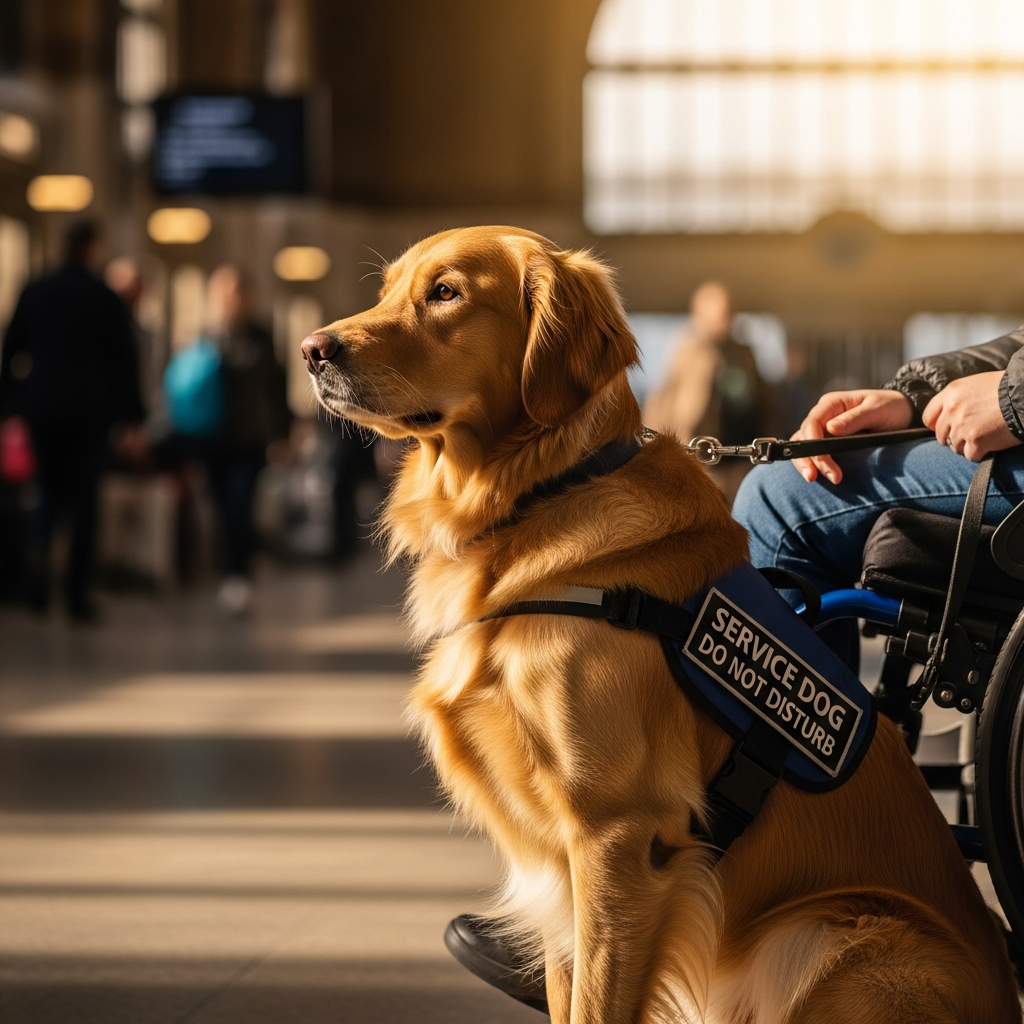
Service dog vests are one of the most misunderstood products in the pet industry. There’s widespread confusion about what the law actually requires, what a vest does and doesn’t do, and how service dogs differ from emotional support animals and therapy dogs.
This guide provides a factual, neutral overview of service dog vests: what the ADA actually says, the different types of vests available, how to size them, and what to consider before purchasing. This is not legal advice — consult a qualified attorney for questions specific to your situation.
What the ADA Actually Says About Service Dogs
The Americans with Disabilities Act (ADA) defines a service animal as a dog that is individually trained to do work or perform tasks directly related to a person’s disability. The key phrase is “individually trained to perform tasks.” The dog must be trained to do something specific that mitigates the handler’s disability.
What the ADA Does Not Require
- Registration. There is no legitimate national service dog registry required by the ADA. Websites that sell certificates, ID cards, or registrations are not recognized by the Department of Justice.
- Certification. The ADA does not require service dogs to be certified by any organization.
- A vest, harness, or identification. The ADA does not require service dogs to wear any specific gear, including vests. A service dog can be identified solely through the handler’s answers to two permitted questions (see below).
- A specific breed. Any breed of dog can be a service animal.
- Professional training. Service dogs can be owner-trained. The ADA does not require that training come from a professional organization.
The Two Questions
Under the ADA, when it is not obvious that a dog is a service animal, a business or entity may ask only two questions:
- Is the dog a service animal required because of a disability?
- What work or task has the dog been trained to perform?
They cannot ask about the handler’s disability, require documentation, or demand a demonstration.
Where Service Dogs Are Allowed
Under the ADA, service dogs are permitted in all areas where the public is normally allowed. This includes restaurants, stores, hotels, hospitals, and public transportation. Housing is covered under the Fair Housing Act, and air travel is covered under the Air Carrier Access Act, each with their own specific rules.
Service Dog vs. Emotional Support Animal vs. Therapy Dog
These three categories are frequently confused, and they have very different legal standings.
Service Dog
- Individually trained to perform specific tasks related to a handler’s disability
- Protected under the ADA for public access
- No breed, size, or age restrictions
- No registration or certification required by federal law
Emotional Support Animal (ESA)
- Provides comfort through companionship, but is not trained to perform specific tasks
- Not protected under the ADA for public access. Businesses are not required to allow ESAs.
- Protected under the Fair Housing Act for housing accommodations (with documentation from a licensed mental health professional)
- Not required to be a dog — ESAs can be any domesticated animal
- As of 2021, airlines are no longer required to accommodate ESAs in the cabin
Therapy Dog
- Trained to provide comfort to people in facilities such as hospitals, schools, and nursing homes
- Not a service dog under the ADA
- Has no public access rights beyond the facilities where they’re invited to work
- Typically certified through organizations like Pet Partners or Therapy Dogs International
Why People Use Service Dog Vests
Although the ADA does not require a vest, many service dog handlers choose to use one for practical reasons:
- Signaling working status. A vest with “Service Dog” or “Working Dog” patches communicates that the dog is on duty, reducing interruptions from well-meaning people who want to pet the dog.
- Reducing access challenges. While businesses should allow service dogs regardless of gear, a visible vest can reduce confrontations and the need to repeatedly explain the dog’s status.
- Providing functional attachment points. Many service dog vests include pockets, handles, and D-rings that are useful for the handler.
- Creating focus for the dog. Some handlers find that the vest signals “work mode” to the dog, helping them distinguish between working time and off-duty time.
Types of Service Dog Vests
Cape-Style Vests
A lightweight fabric panel that drapes over the dog’s back with straps around the chest and belly. This is the most common service dog vest style.
Pros: Lightweight, easy to put on and remove, visible patch area on both sides, comfortable for most dogs. Cons: Minimal functionality beyond identification. No handle, no pockets, limited attachment points. Best for: Handlers who primarily need visibility and identification.
Harness-Style Vests
A more structured garment that functions as both a harness and a vest. These typically include a handle on the back, leash attachment points, and side pockets.
Pros: Multi-functional (harness + identification + storage), the handle is useful for handlers who need physical support from their dog, more secure fit than a cape. Cons: More complex to fit correctly, heavier, can be warm in hot weather. Best for: Handlers whose dogs perform mobility tasks (bracing, balance assistance, forward momentum pull), handlers who need gear storage.
Wrap-Style Vests
A padded vest that wraps around the dog’s torso with Velcro closures. Similar to a cape but with more body coverage and padding.
Pros: Easy on/off with Velcro, large patch area, padded for comfort, good for dogs with sensitive skin. Cons: Velcro can weaken over time, less secure than buckle harnesses, can be noisy (Velcro sound). Best for: General identification, handlers who need quick on/off capability, dogs in warm climates (less material than a harness vest).
How to Choose a Service Dog Vest
Fit
A service dog vest must fit correctly to be comfortable for extended wear. Dogs in service typically wear their vest for hours at a time, so any rubbing, restriction, or pressure will create problems.
Measuring:
- Chest girth: Around the widest part of the ribcage, behind the front legs.
- Neck: Around the base of the neck.
- Length: From the base of the neck to the base of the tail.
The vest should sit flat without bunching, allow full range of motion in the front legs, and not ride up toward the neck.
Material
- Breathable mesh for warm climates and active dogs
- Nylon for durability and weather resistance
- Padded neoprene for comfort during long wear
- Reflective material for handlers who work or travel in low-light conditions
Patches
Most service dog vests have Velcro panels for removable patches. Standard patches include “Service Dog,” “Working Dog,” “Do Not Pet,” and “Ask to Pet.” Choose patches that clearly communicate your dog’s working status. Custom patches with specific messages are widely available.
Handle (If Needed)
If your dog performs mobility assistance tasks (bracing, balance, forward momentum pull), a rigid handle mounted to a harness-style vest is essential. The handle should be positioned where you can comfortably grip it while standing, and it must be strong enough to bear your weight during a balance moment.
If your dog does not perform mobility tasks, a handle is unnecessary and adds weight.
Top Service Dog Vest Picks
For Identification (Cape/Wrap Style): Industrial Puppy Service Dog Vest
Price: $15–$25 | Sizes: XS to XL
A straightforward identification vest with clear “Service Dog” patches on both sides and a reflective trim. Lightweight, breathable, and easy to put on. It does one thing — clearly identify your dog as a service animal — and does it well.
What I like:
- The patches are large and easily readable from a distance
- Mesh construction is breathable
- The price point is accessible
- Includes two removable “Service Dog” patches
- Reflective piping for low-light visibility
What I don’t:
- No functional features (no handle, no pockets, no leash attachment)
- The Velcro closures can weaken with heavy use
- Sizing runs slightly large
For Mobility Tasks (Harness Style): Dogline Unimax Multi-Purpose Harness
Price: $30–$45 | Sizes: S to XL
A dual-purpose harness that functions as both a walking harness and a service dog vest. The rigid handle provides balance support, and the chest and back D-rings allow for leash attachment in multiple configurations.
What I like:
- The rigid handle is genuinely functional for balance assistance
- Chest and back D-ring for leash versatility
- Removable Velcro patch panels on both sides
- Padded chest plate for comfort
- Adjustable at four points for a precise fit
What I don’t:
- More complex to fit than a cape-style vest
- The handle position may need adjustment for different handler heights
- Heavier than identification-only vests
For Heavy-Duty Use: Bold Lead Designs Custom Harness
Price: $150–$300 | Custom sizing available
For handlers whose dogs perform critical mobility or medical alert tasks, a custom-fitted harness provides the best combination of function, durability, and fit. Bold Lead Designs makes harnesses specifically for working service dogs, with options for handles, pockets, and task-specific configurations.
What I like:
- Custom fit to your specific dog
- Materials and construction designed for daily, long-term use
- Configurable for specific tasks
- Made in the USA
What I don’t:
- Premium price
- Lead time for custom orders
- Not available for immediate purchase
Important Considerations
Vest Does Not Equal Service Dog Status
Purchasing a vest does not make a dog a service dog. Under the ADA, the dog’s training and the handler’s disability determine service dog status, not any piece of equipment. A vest is a practical tool, not a credential.
Misrepresentation
Many states have laws against misrepresenting a pet as a service animal. Penalties vary by state and may include fines. Using a service dog vest on a dog that is not trained to perform tasks related to a disability may constitute misrepresentation, depending on the context and jurisdiction.
Training Is the Foundation
A service dog’s value comes from its training, not its equipment. A well-trained service dog without a vest is far more effective than an untrained dog wearing one. If you are considering a service dog, invest in proper training — either through a program or through owner-training with guidance from a professional.
State and Local Laws
While the ADA provides a federal baseline, individual states may have additional laws regarding service animals. Some states offer voluntary identification programs. Some have specific laws regarding ESAs and therapy dogs. Check your state’s laws for the most current regulations.
Frequently Asked Questions
Does the ADA require my service dog to wear a vest?
No. The ADA does not require service dogs to wear vests, ID tags, or any specific gear. However, many handlers choose to use vests for practical reasons, including reducing public confrontations and signaling the dog’s working status.
Can a business ask me to prove my dog is a service dog?
A business may ask two questions: (1) Is the dog a service animal required because of a disability? (2) What work or task has the dog been trained to perform? They cannot require documentation, certification, or a demonstration.
Where can I register my service dog?
There is no legitimate national service dog registry recognized by the ADA. Websites that sell certificates, ID cards, or registrations are not required or recognized by federal law. You do not need to register your service dog.
What’s the difference between a service dog vest and a regular harness?
Functionally, a service dog vest often includes patch panels for identification, a handle for mobility assistance, and pockets for gear. A regular harness is designed for walking control. Some products serve both functions. The identifying patches are what visually distinguish a service dog vest from a walking harness.
Can an emotional support animal wear a service dog vest?
An emotional support animal is not a service animal under the ADA. Using a service dog vest on an ESA could constitute misrepresentation of a service animal, which is prohibited by law in many states. ESAs and service dogs have different legal protections and different definitions.
How do I get a service dog?
This guide covers gear, not the process of obtaining or training a service dog. If you believe a service dog could assist with a disability, consult with your healthcare provider and research accredited service dog organizations. Owner-training is permitted under the ADA, but professional guidance is strongly recommended.
Prices last updated February 2026. We use affiliate links — if you purchase through our links, we may earn a commission at no extra cost to you.
Back to the Dog Gear hub for more tested recommendations.