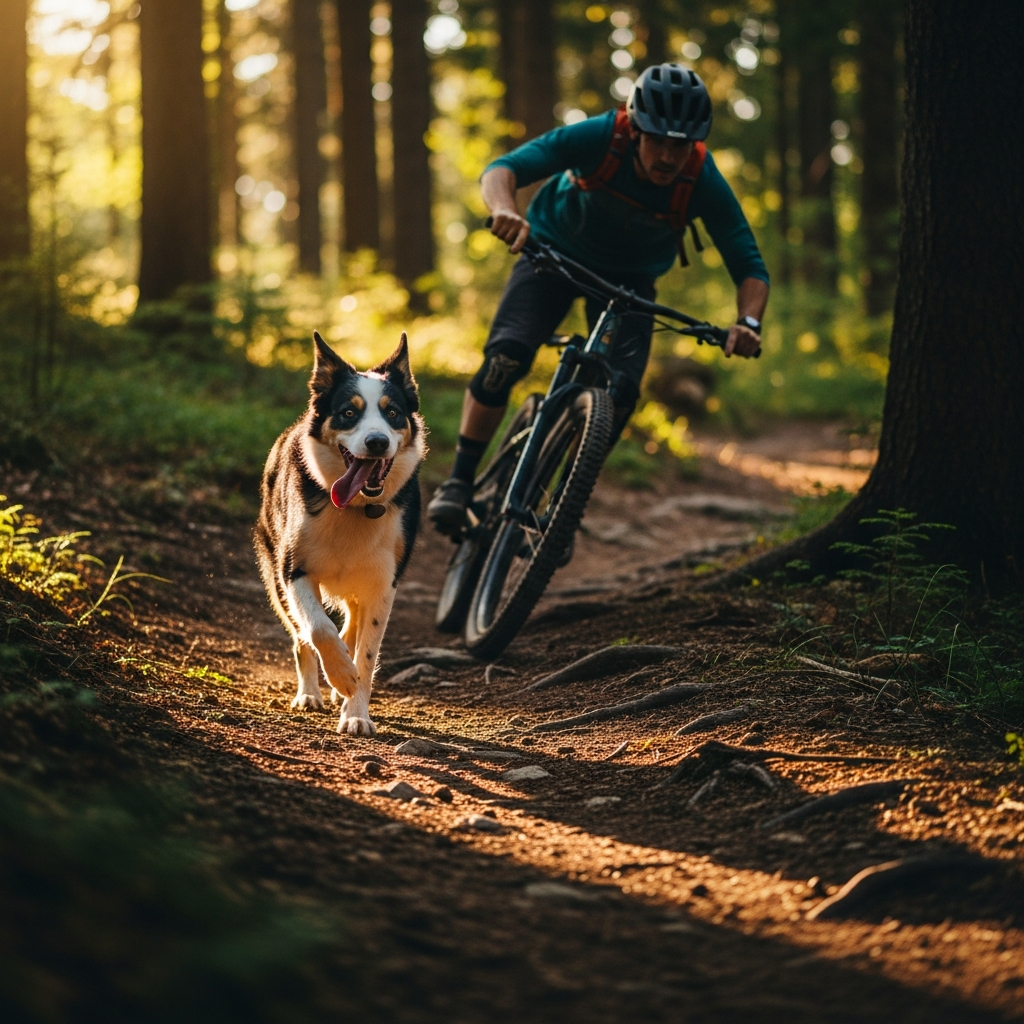
I still remember the first time my dog ran alongside my bike on a fire road in the mountains. She locked into this effortless lope, tongue out, ears back, completely in her element. We covered 8 miles in an hour and she could’ve kept going. It was the happiest I’d ever seen her, and it ruined me - because from that moment on, every ride without her felt incomplete.
Mountain biking with your dog is, hands down, one of the most exhilarating things you can do together. It combines everything dogs love - running, exploring, problem-solving on terrain - with speed and distance that walking can’t match. Your dog gets to be the athlete they’re built to be.
But I’m going to be straight with you: this is not a beginner activity. Not for you and not for your dog. Mountain biking with a dog requires serious prerequisites on both sides, and skipping them puts your dog (and other trail users) at real risk. I’ve seen it go wrong, and it’s not pretty.
This guide covers the honest truth about what it takes: fitness requirements, training prerequisites, the commands you actually need, trail selection, safety protocols, and how to build up to it gradually. If you and your dog are ready, this is the most rewarding adventure you’ll share. If you’re not ready yet, this guide will tell you exactly how to get there.
Is Your Dog Ready? The Fitness Prerequisites
This is where most people underestimate. Your dog needs to be a genuine athlete before they run alongside a bike on technical terrain. Running next to a bike is significantly more demanding than hiking - the pace is faster, the duration is longer, and the terrain requires constant adjustment.
Physical Requirements
Age: Your dog must be fully physically mature. For most breeds, that means at least 18-24 months old. Large and giant breeds take longer for growth plates to close. Starting a young dog on high-impact running alongside a bike is a recipe for joint damage that shows up years later. This is non-negotiable. No puppies.
Baseline fitness: Your dog should already be comfortably running 5-8 miles on varied terrain before you introduce the bike. If they can’t do that, they’re not ready. Start with hiking and trail running. Our hiking guide covers the fitness-building progression.
Breed considerations: High-energy, athletic breeds excel at this - Australian Shepherds, Border Collies, Vizslas, Weimaraners, German Shorthaired Pointers, Rhodesian Ridgebacks, and similar working/sporting breeds. Mixed breeds with similar builds and energy levels do great too. Brachycephalic breeds (Bulldogs, Pugs, Boxers) should not mountain bike - their airway limitations make sustained high-intensity exercise dangerous. Giant breeds and breeds prone to joint problems need extra caution.
Joint health: Before starting any sustained running program, a vet check is smart. Hip and elbow evaluations are especially important for breeds prone to dysplasia. If your dog has any history of limping, stiffness, or joint issues, get them evaluated before adding the stress of trail running at bike pace.
Weight: Your dog needs to be at a healthy weight. Extra pounds multiply the stress on joints during high-impact running. If your dog is overweight, address that first through diet and moderate exercise before introducing biking.
Building Fitness Progressively
Don’t go from neighborhood walks to a 10-mile bike ride. Here’s a reasonable progression:
Weeks 1-4: Regular hiking, 3-5 miles, with elevation. Build a fitness base on foot first.
Weeks 5-8: Trail running together. Start at 2-3 miles and build to 5-8 miles over four weeks. This teaches your dog to run on varied terrain at a faster pace.
Weeks 9-10: Introduce the bike on flat, wide paths. Your dog runs alongside while you pedal slowly. Very short distances (1-2 miles). This is about getting your dog comfortable with the bike, not about fitness.
Weeks 11-14: Gradually increase distance on the bike, still on easy terrain. Build from 3 miles to 6-8 miles. Add gentle hills.
Week 15+: Begin riding on actual singletrack trails, starting with easy, wide trails and working toward more technical terrain as your dog’s trail sense develops.
This is a minimum 15-week program. Rushing it increases injury risk for your dog and creates dangerous situations on the trail.
Training Prerequisites: The Commands That Matter
Physical fitness without reliable training is dangerous at bike speed. Your dog needs specific skills that go beyond basic obedience.
Non-Negotiable Commands
Recall (“Come” or “Here”): This has to be absolutely bulletproof. Not “comes most of the time.” Not “comes when there’s nothing interesting happening.” Your dog must come to you immediately when called, even when they’re running at full speed, even when a deer just crossed the trail, even when another dog appears. If your recall isn’t there, your dog stays home. Test it with high-value distractions before you trust it on the trail.
“Wait” or “Whoa”: Your dog needs to stop and hold position on command. You’ll use this at trail intersections, when other users approach, at water crossings, and any time you need a moment to assess the situation ahead. This command has to work at distance - your dog may be 30 feet ahead when you need them to stop.
“Behind”: Your dog runs behind you, not alongside or in front. On singletrack trails, this is essential. A dog that cuts in front of the bike creates a crash risk for both of you. “Behind” means they tuck in behind the rear wheel and hold that position until released.
“Trail” or “Over”: Move to the side of the trail. Used when other users are approaching and you need your dog out of the way. Some riders use “right” and “left” for specific directions, but a general “move to the side” command works fine for most situations.
“Leave It”: Your dog encounters dead animals, horse manure, food wrappers, and other dogs on the trail. They need to pass these without engaging. At bike speed, you don’t have time to physically intervene. This command has to be voice-only and reliable.
How to Train Trail Commands
Start on foot. All trail commands should be taught and proofed during hikes before you ever introduce the bike.
“Behind” training: During hikes, use a treat to lure your dog behind you. Mark the position with a clicker or “yes” and reward. Practice on narrowing trails where the position makes intuitive sense. Gradually add the verbal cue and fade the lure. Proof it with distractions - other people, other dogs, wildlife sounds.
“Wait” training: Start with a basic “stay” and build distance and duration. Then practice while moving - you walk forward, say “wait,” and your dog stops while you continue. This translates directly to the bike situation where you’re moving and your dog needs to stop.
Practice these commands during trail runs (the pre-bike phase) so your dog associates them with running at speed, not just walking.
Trail Selection: Where to Ride and Where Not To
Not all trails are appropriate for biking with a dog, and choosing the wrong trail can be dangerous for your dog, annoying for other users, and bad for the trail system.
Ideal Trails for Biking With Dogs
Wide fire roads and doubletrack: These are your starting trails. Room for your dog to run alongside without being directly in front of or behind the bike. Good sightlines for seeing other users. Lower technical difficulty means fewer hazards.
Flowy singletrack with good sight lines: Once your dog has trail sense, moderate singletrack with long sight lines works well. You can see what’s coming and call commands in advance. Avoid blind corners until your dog’s “behind” command is rock solid.
Low-traffic trails: Fewer encounters with other users means fewer situations to manage. Early morning and midweek rides are ideal for this. Check trail counter data or local knowledge for traffic patterns.
Trails with water access: Your dog is working harder than you are. Streams and lakes along the trail let them cool off and hydrate naturally. Plan routes with water access, especially in warm weather.
Trails to Avoid
High-traffic trails: Crowded trails mean constant encounters with hikers, other bikers, and other dogs. Managing your dog through these encounters while riding is stressful and risky. Don’t be that person.
Steep, technical descents: Your bike picks up speed on descents, and your dog can’t slow down as quickly. Steep, rocky descents are where crashes happen. Your dog can stumble, you can’t stop in time, and the consequences are real. Stick to moderate terrain.
Cliff-side or exposed trails: Trails with significant exposure (drop-offs, narrow ridgeline) are dangerous for a dog running at speed. One misstep or one chase impulse and your dog is off the edge.
Trails that prohibit dogs or bikes: Check the rules. Many trail systems have specific designations for bikes, hikers, and dogs. Riding with your dog on a trail that doesn’t allow either is how trails get closed to everyone.
Trails with heavy wildlife: If you’re in bear country, mountain lion territory, or an area with frequent deer, your dog’s chase instinct is a serious risk factor. Even the best recall can fail when a prey animal breaks from the brush at 20 feet.
On the Trail: Riding Protocol
Once you’re out there, these protocols keep everyone safe.
Pace Management
Your dog sets the pace. This is the fundamental rule. You are faster on a bike than your dog is on foot, and the temptation to push the pace is real. But your dog will run themselves into the ground trying to keep up with you. They will not quit. They will not tell you they’re tired. They’ll run until something breaks.
Sustainable trot, not a sprint. Your dog should be moving at a comfortable trot - not a flat-out run. If they’re sprinting to keep up, you’re going too fast. A dog’s efficient running gait is a loping trot, and you should be pedaling slowly enough that they can maintain it.
Watch for fatigue cues: Heavy panting that doesn’t slow during brief stops, lagging behind (even slightly), tongue hanging very long and wide, drooling more than normal, stiffness in gait. If you see any of these, stop. Water, shade, rest. If they don’t recover in 10 minutes, the ride is over.
Trail Positioning
The default position is behind you. Your dog runs behind your bike on singletrack. This gives you the first look at obstacles, other users, and hazards. Your dog follows your line.
On fire roads and doubletrack: Your dog can run alongside, which is more natural for them and easier for both of you. They’ll naturally gravitate to one side. Let them choose and keep that side consistent.
At intersections and encounters: Call “wait” or “behind” before you reach the intersection or other user. Don’t wait until you’re in the middle of the situation. Give your dog time to process the command at speed.
Encounters With Other Trail Users
Hikers: Slow to a crawl or stop. Call your dog to your side or behind you. Yield the trail. A polite “dog behind me” lets the hiker know what to expect. Don’t assume they’re comfortable with dogs.
Other bikers: Signal and call your dog to the side. Passing another biker with a dog running loose is one of the highest-risk situations. If the other biker has their own dog, stop completely and manage the interaction.
Horses: Stop completely. Get off the bike. Move to the downhill side of the trail and hold your dog. Horses can be terrified of bikes and of dogs, and a horse spooking on a trail is dangerous for everyone involved. Give the horse the full trail and wait until they’re well past.
Safety and First Aid
Common Injuries
Paw pad tears: The most frequent injury. Sharp rocks, hot surfaces, and sustained running on rough terrain wear paw pads down. Dog boots prevent most pad injuries, and I strongly recommend them for rocky trails. If a pad tears, clean it, bandage it, and end the ride. See our paw pad injury guide for first aid details.
Muscle strains: Usually show up as limping that develops during or after the ride. Stop immediately if you notice limping. Rest, ice (if available), and a vet visit if it doesn’t resolve in 24-48 hours.
Heat-related illness: Dogs overheat faster than humans and can’t cool down efficiently during sustained exercise. Watch for excessive panting, drooling, stumbling, or disorientation. If you suspect heat exhaustion, stop immediately, get to water, cool your dog down, and get to a vet.
Cuts and scrapes: Brush, rocks, and branches can cause cuts, especially on the legs and belly. Minor cuts can be cleaned and monitored. Deep cuts or heavy bleeding mean the ride is over.
Gear for Safety
- A well-fitted harness that doesn’t restrict shoulder movement (your dog needs full range of motion for running)
- Dog boots for rocky or hot terrain
- A small first aid kit in your hydration pack (gauze, antiseptic wipes, self-adhesive bandage)
- Extra water (always)
- High-value treats for emergency recall reinforcement
- A spare leash clipped to your pack (for situations where your dog needs to be leashed immediately)
Weather and Seasonal Considerations
Heat is the biggest threat. Your dog generates enormous heat during sustained running and can only cool down through panting. Above 70 degrees Fahrenheit, reduce distance and intensity significantly. Above 80 degrees, don’t ride with your dog. Morning rides in summer are not optional - they’re essential.
Cold weather is generally ideal. Dogs dissipate heat better in cool air, and cool-weather rides are when they perform best. Watch for ice on trails (slippery for both of you) and cold-related paw issues (snow balling between pads). Boots solve the paw issue.
Wet trails: Muddy trails are slippery for your dog and can hide sharp objects. Reduce speed and avoid technical sections when trails are wet. Your dog’s footing is less secure in mud, which increases strain on joints.
Hunting season: If you ride in areas where hunting occurs, outfit your dog in a bright orange vest. Seriously. A dog running through brush at distance looks a lot like a deer to an inattentive hunter. Check your local hunting season dates and consider avoiding those areas entirely.
Building Your Mountain Biking Dog: A Summary
This is a commitment. It’s not something you decide on Saturday morning and do that afternoon. Here’s the honest summary of what it takes:
- Your dog is physically mature (18-24 months minimum) and in excellent health
- You’ve built a fitness base through months of progressive hiking and trail running
- Your dog has reliable recall, wait, behind, and leave-it commands that work with distractions at speed
- You’ve conditioned your dog to the bike starting with flat, wide paths and building gradually
- You choose appropriate trails - low traffic, moderate terrain, good sight lines, water access
- You ride at your dog’s pace, not yours, and watch constantly for fatigue cues
- You carry safety gear and know basic first aid for trail injuries
If all of that is in place, you’re ready. And what awaits is one of the most pure, connected, joyful experiences you can have with your dog. The day your dog locks into that lope alongside your bike, ears back, eyes forward, completely in flow - you’ll understand why people dedicate so much time to getting here.
For more adventure ideas and the gear that makes them possible, head back to our dog lifestyle hub or check out 25 fun things to do with your dog.
Frequently Asked Questions
What breeds are best for mountain biking?
Athletic, medium-sized breeds with high endurance thrive at mountain biking. Australian Shepherds, Border Collies, Vizslas, Weimaraners, German Shorthaired Pointers, Rhodesian Ridgebacks, and many herding/sporting breed mixes are excellent candidates. Mixed-breed dogs with athletic builds and high energy often excel too. Brachycephalic breeds should not mountain bike due to airway limitations. Very small dogs and giant breeds are also poor fits - small dogs can’t maintain the pace, and giant breeds face excessive joint stress.
How far can a dog run alongside a bike?
A conditioned, athletic dog can comfortably cover 8-15 miles alongside a bike at a moderate pace on moderate terrain. Some exceptional dogs can go further, but that’s the comfortable range for most trail-conditioned dogs. Distance should always be dictated by your dog’s fatigue cues, not by a mileage goal. When starting out, keep rides under 5 miles and build up gradually over weeks.
Is mountain biking with my dog legal?
This depends entirely on the specific trail and land management rules. Some trail systems welcome both bikes and dogs. Others allow bikes but not dogs (or vice versa). Leash laws may apply even in off-leash areas when bikes are involved. Always check trail-specific rules before riding. National parks generally prohibit dogs on trails. National forests and BLM land are often more permissive. Local trail advocacy groups are the best resource for current rules.
What if my dog chases wildlife?
If your dog has a strong prey drive and unreliable recall when wildlife appears, they’re not ready for off-leash mountain biking. Period. Work on recall in the presence of wildlife during on-leash hikes until it’s reliable. Even then, some dogs will never be trustworthy off-leash around certain prey animals. Know your dog and be honest about their limitations. A long line during the training phase lets you maintain control while building reliability.
Do I need special equipment for my bike?
No special bike modifications are needed. The most useful addition is a bell - ringing it alerts your dog and other trail users to your position. Some riders attach a “Bikes With Dogs” flag to their pack, which is a nice courtesy. The main equipment investment is on the dog side: a running harness, boots for rough terrain, and a small first aid kit in your hydration pack.
Can my dog run alongside a road bike or e-bike?
Road biking with a dog is generally a bad idea - road speeds are too fast for a dog to sustain, traffic is a major hazard, and pavement is brutal on paw pads. E-bikes on trails are fine as long as you ride at dog pace, not e-bike pace. The temptation to use the motor to go faster defeats the purpose. Your dog can’t go faster just because your bike can. Use the assist for hills and keep your speed appropriate for your dog’s trot.