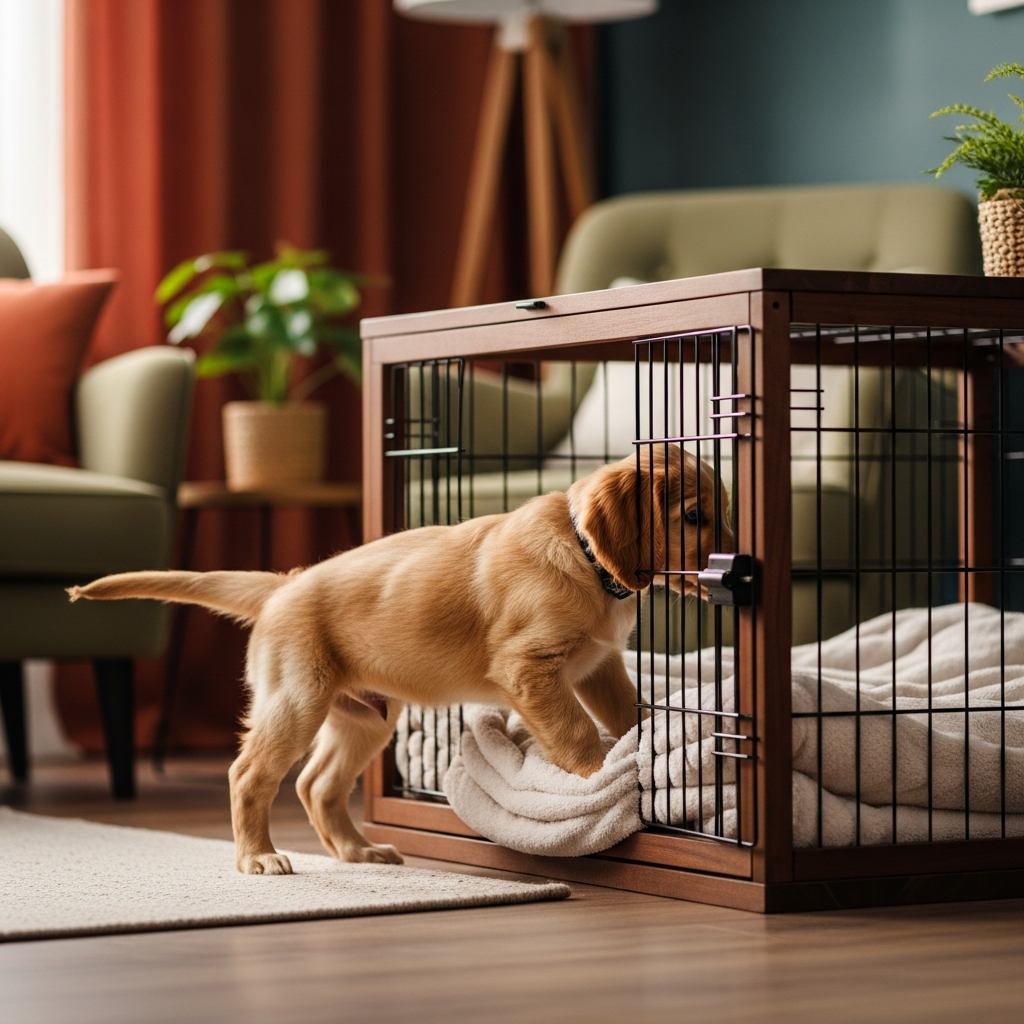
Crate training gets a bad reputation because people think of it as putting their dog in jail. I get it - it looks that way if you do it wrong. But done right, a crate becomes your dog’s favorite place: their den, their safe space, the one spot in the house that is entirely theirs.
My first dog hated the crate. Why? Because I did everything wrong. I shoved her in, shut the door, and left for work. She screamed for two hours, bent the bars, and I came home to a terrified dog and a mountain of guilt. The second time around, with a different dog and a better plan, crate training took five days with zero crying.
The difference was not the dog. It was the approach.
This guide walks you through the entire process - from choosing the right crate to your dog happily sleeping in it overnight. No crying, no force, no guilt. Just a systematic positive reinforcement plan that works for puppies and adult dogs alike.
If you are starting with a new puppy, pair this with our new puppy checklist for a complete first-week game plan. For the broader training framework, visit our complete dog training guide.
Why Crate Training Matters
A crate-trained dog has significant advantages:
Housetraining becomes easier. Dogs instinctively avoid soiling their sleeping area. A properly sized crate leverages this instinct and gives your puppy a clear structure: crate time means holding it, outside time means going.
Destructive behavior is prevented. When you cannot supervise, the crate keeps your dog safe from chewing electrical cords, eating socks, or destroying furniture. This is management, not punishment - you are preventing bad habits from forming in the first place.
Travel is less stressful. A dog who is comfortable in a crate can travel in a car, stay in a hotel, or be boarded without the added stress of confinement anxiety.
Veterinary stays are easier. If your dog ever needs surgery or overnight observation, they will be in a crate or kennel at the vet. A dog who already associates crates with safety and comfort handles this dramatically better.
It becomes their safe space. Once crate training is complete, most dogs choose to go to their crate when they want to decompress. Thunderstorms, fireworks, guests in the house - the crate becomes the place your dog retreats to when they need to feel secure.
Choosing the Right Crate
The crate itself matters more than people think. The wrong size or style can make the process harder or even counterproductive.
Size
Your dog should be able to stand up, turn around, and lie down comfortably. That is it. Bigger is not better - a crate that is too large gives your puppy room to use one end as a bathroom, which defeats the housetraining benefit.
For puppies, buy a crate sized for their adult dimensions and use a divider panel to reduce the usable space. Move the divider as they grow. For our specific product recommendations, check out our best dog crate guide.
Type
- Wire crates offer the best ventilation and visibility. Most come with divider panels. They fold flat for storage. This is the best all-around option for home crate training.
- Plastic crates are more enclosed and den-like. Some dogs prefer this. They are also airline-approved for travel.
- Soft-sided crates are lightweight and portable but not suitable for puppies or dogs who might chew or claw their way out.
Placement
Put the crate in a common area where your family spends time - living room or bedroom. Dogs are social animals, and isolating them in a garage or laundry room makes the crate feel like exile. At night, the crate should be in or near your bedroom so your puppy can hear and smell you.
The 5-Day Crate Training Protocol
This is a step-by-step protocol that works for both puppies and adult dogs. The timeline is a guideline - some dogs move faster, some slower. Let your dog’s comfort level dictate the pace, not the calendar.
Day 1: Introduction and Exploration
Goal: Your dog voluntarily enters the crate and associates it with good things.
- Set up the crate with the door open. Remove the door entirely if possible, or secure it wide open so it cannot swing and startle your dog.
- Make the crate comfortable. Put a soft blanket or bed inside, along with a familiar-smelling item (your worn t-shirt works well).
- Scatter treats around and inside the crate. Put a few near the entrance, a few just inside, and a few at the back. Let your dog discover them at their own pace.
- Do not push, lure aggressively, or force your dog inside. Let them investigate. If they only eat the treats near the entrance today, that is fine.
- Feed their meal near the crate. Start with the bowl just outside the crate, then move it to the entrance, then just inside. Progress as fast as your dog is comfortable.
What you are building: A positive association with the crate as a place where good things appear.
Day 2: Voluntary Entry
Goal: Your dog goes all the way into the crate willingly.
- Toss high-value treats into the back of the crate periodically throughout the day. Let your dog go in, grab them, and come back out freely.
- Start feeding meals inside the crate. Place the bowl at the back. Your dog should be comfortable going all the way in by now. If not, move the bowl as far in as they will go and push it deeper at each meal.
- When your dog is inside eating, gently close the door. Open it before they finish eating. The door closes while something good is happening and opens before any anxiety builds.
- If your dog shows resistance to entering, go back to step one. There is no timeline penalty for going slower.
What you are building: Confidence going all the way in, and a first experience with the door closed (briefly and positively).
Day 3: Closed Door, Short Duration
Goal: Your dog stays in the crate with the door closed for increasing periods.
- After your dog enters and begins eating, close the door. This time, wait until they finish eating before opening it. They should be calm.
- Start doing short crate sessions outside of meals. Lure your dog in with a treat, close the door, wait 30 seconds. If they are calm, open the door and treat. If they whine, wait for a pause in the whining (even one second of silence), then open the door.
- Gradually increase the duration: 30 seconds, one minute, two minutes, five minutes. Stay in the same room where your dog can see you.
- Give a frozen Kong or long-lasting chew when you close the door. This occupies them and creates a strong positive association - the crate is where the best treats happen.
Critical rule: Never open the door while your dog is whining. Wait for even a brief moment of quiet, then open it. Opening during whining teaches: “whining opens the door.”
Day 4: Out of Sight
Goal: Your dog stays calm in the crate while you leave the room.
- Put your dog in the crate with a Kong or chew. Close the door.
- Stay in the room for two to three minutes, then casually walk out. No dramatic goodbye, no fanfare. Just leave.
- Stay out of sight for one minute, then return casually. Do not make a big deal of your return either. Calm departures and calm arrivals teach your dog that your comings and goings are boring and normal.
- Gradually increase your out-of-sight time: two minutes, five minutes, ten minutes, twenty minutes.
- Mix up the duration. Do not always go longer. Sometimes be gone for ten minutes, then five, then fifteen. Randomness prevents your dog from predicting and escalating.
Day 5: Extended Time and Overnight
Goal: Your dog is comfortable in the crate for one to two hours and overnight.
- Do a one-hour crate session while you are home but out of sight. Give a stuffed Kong at the start.
- If your dog is calm, you are ready for overnight crate training. Move the crate to your bedroom (or near it) so your dog can hear you breathing.
- Before bedtime, exercise your dog well, take them out for a bathroom break, and then put them in the crate with a quiet “bed” or “crate” cue.
- For puppies, set an alarm for a middle-of-the-night bathroom break. Puppies under four months cannot hold it for eight hours. Take them out quietly, let them go, and put them right back.
- Expect some settling noises the first night or two. Brief whining that settles within five minutes is normal. Extended, escalating distress is a sign you need to slow down.
After the Protocol: Building Crate Habits
Once your dog is comfortable in the crate, here is how to maintain and strengthen the habit:
The Crate Cue
Teach a specific word - “crate,” “bed,” “kennel,” or “place” - that means go to your crate. Start by saying the word just before you toss a treat inside. Eventually your dog will hear the word and go in on their own.
Practice this randomly throughout the day, not just when you are leaving. If the crate cue only happens when you leave, your dog will start to see the crate as a predictor of your absence.
How Long Is Too Long?
General guidelines for crate time:
- Puppies (8-10 weeks): 30-60 minutes (plus overnight with bathroom breaks)
- Puppies (11-14 weeks): 1-3 hours
- Puppies (15-16 weeks): 3-4 hours
- Puppies (6 months+): 4-6 hours
- Adult dogs: Up to 8 hours (but 4-6 is better)
These are maximums, not targets. A dog who spends all day in a crate and all night in a crate is spending too much time confined. If your work schedule requires long crate time, arrange for a midday dog walker, a neighbor check-in, or consider doggy daycare.
Crate Games
Keep the crate positive long after the initial training is complete:
- Hide treats in the crate randomly throughout the day
- Feed meals in the crate a few times per week
- Give special chews (bully sticks, frozen Kongs) exclusively in the crate
- Practice “crate, free” repetitions - ask your dog to go in, mark, treat, release, repeat
Crate vs. Playpen vs. Free Roam
A common question is whether to use a crate, a playpen (exercise pen), or just let your dog have free roam of the house. Here is how to think about it:
Crate: Best for housetraining, overnight, and short-duration confinement. The enclosed space triggers the den instinct and bladder control. However, a crate is not ideal for all-day confinement.
Playpen: Best for longer unsupervised periods when your dog is past the housetraining stage but not yet trustworthy in the house. A playpen gives more room to move, stretch, and play. You can put the crate inside the playpen with the door open, giving your dog access to their den and play space.
Free roam: The eventual goal for most dogs. Gradually increase your dog’s freedom room by room as they prove trustworthy. Most dogs earn full house privileges between one and two years of age, but it varies.
The progression for most dogs is: crate → crate inside playpen → playpen alone → one room → multiple rooms → full house.
Common Crate Training Mistakes
Forcing Your Dog Into the Crate
Never push, shove, or drag your dog into the crate. This creates a negative association that can take weeks to undo. Every crate entry should be voluntary. If your dog will not go in, you need to increase the value of what is inside (better treats, better chew toys) or slow down your protocol.
Using the Crate as Punishment
“Go to your crate” said in anger after your dog chews a shoe undoes your training. The crate must always be associated with good things. If you need to separate your dog from a situation, calmly lead them to the crate and give them a treat. The emotion should be neutral or positive, never punitive.
Starting With Too Much Too Fast
Closing the door and leaving for three hours on day one is a recipe for a dog who hates their crate. Follow the gradual protocol. Five days invested now saves months of problems later.
Opening the Door During Whining
This is the hardest rule to follow, but it is the most important. If you open the door while your dog is whining, you teach them that whining works. Wait for quiet - even a two-second pause - and then open. If the whining is intense and not settling, you moved too fast in your protocol. Go back a step.
Important exception: If a puppy is whining and it has been more than an hour since their last bathroom break, they may genuinely need to go out. Take them out quietly, let them go, and put them right back. Do not turn it into a play session.
Crating for Too Long
A crate is not a dog sitter. It is a training tool and a safe space. Eight hours at work plus eight hours overnight equals sixteen hours of crate time per day, which is way too much. If your schedule requires long crate periods, you need a midday break - dog walker, pet sitter, neighbor, or daycare.
Crate Training an Adult Dog
The protocol above works for adult dogs too, but with a few adjustments:
- Adult dogs may have negative crate associations from previous homes. Go extra slowly. Spend several days on each step if needed.
- Adult dogs have better bladder control so overnight training is usually faster.
- Adult dogs may have stronger opinions. Some adult dogs genuinely dislike confinement. If your adult dog shows extreme stress (drooling, panting, trying to escape, self-injury), this may be separation anxiety rather than a crate training issue. Consult a professional.
Crate Training and Separation Anxiety
It is important to distinguish between a dog who is not yet crate trained (whines because the process is new) and a dog with separation anxiety (panics because you left).
Normal crate adjustment whining:
- Brief (settles within 5-10 minutes)
- Low-intensity (whining, not screaming)
- Improves each session
- Stops when you return
Separation anxiety symptoms:
- Intense (howling, screaming, frantic scratching)
- Does not improve over time
- Accompanied by drooling, panting, or self-injury
- Happens whether or not the dog is in a crate
If your dog shows signs of true separation anxiety, crate training alone will not fix it. In fact, forcing a dog with separation anxiety into a crate can make the anxiety worse. Read our separation anxiety guide for a full treatment plan, and consider consulting our dog anxiety health guide for the broader picture.
Frequently Asked Questions
At what age should I start crate training?
You can start the day you bring your puppy home - typically at eight weeks. The earlier you start, the easier it is. But adult dogs of any age can be crate trained too. It just takes a bit more patience.
Should I put a bed or blanket in the crate?
For adult dogs, yes - a comfortable bed or blanket makes the crate more inviting. For young puppies who are still housetraining, use a thin towel or nothing at all until they are reliable. Some puppies will chew and eat bedding, which is a health hazard.
Should I cover the crate?
Many dogs prefer a partially covered crate - it creates a more den-like atmosphere. Cover three sides with a blanket or sheet, leaving the front open. See how your dog responds and adjust.
Should I leave water in the crate?
For short sessions (under two hours), no - it often gets spilled and makes the crate uncomfortable. For longer sessions, use a clip-on water bowl that attaches to the crate door. Ensure your dog has had access to water before being crated.
Can I crate two dogs together?
No. Each dog should have their own crate. Sharing a crate can create resource guarding issues and does not give either dog a true safe space. However, you can place two crates near each other if your dogs are comforted by proximity.
My dog loves the crate but will not let me close the door. What do I do?
Slow down the door-closing phase. Practice touching the door without closing it - mark and treat. Then close it for one second and open it immediately - mark and treat. Then two seconds. Build up so gradually that your dog does not even register the change. Patience here prevents problems later.
Is it okay for my dog to sleep in the crate every night permanently?
Yes, if your dog is comfortable and you are providing enough exercise, enrichment, and freedom during the day. Many dogs choose to sleep in their crate their entire lives even when given the option of sleeping elsewhere. It is their spot.
How do I transition away from the crate?
When your dog is reliably housetrained and no longer destructive (usually between one and two years of age for most dogs), start leaving the crate door open and giving them access to one room. Gradually expand their territory. If they regress, go back to crate management for a while. There is no rush. For more on managing your dog’s adjustment period, see our basic commands guide for the “stay” and “place” commands that help with boundary training.