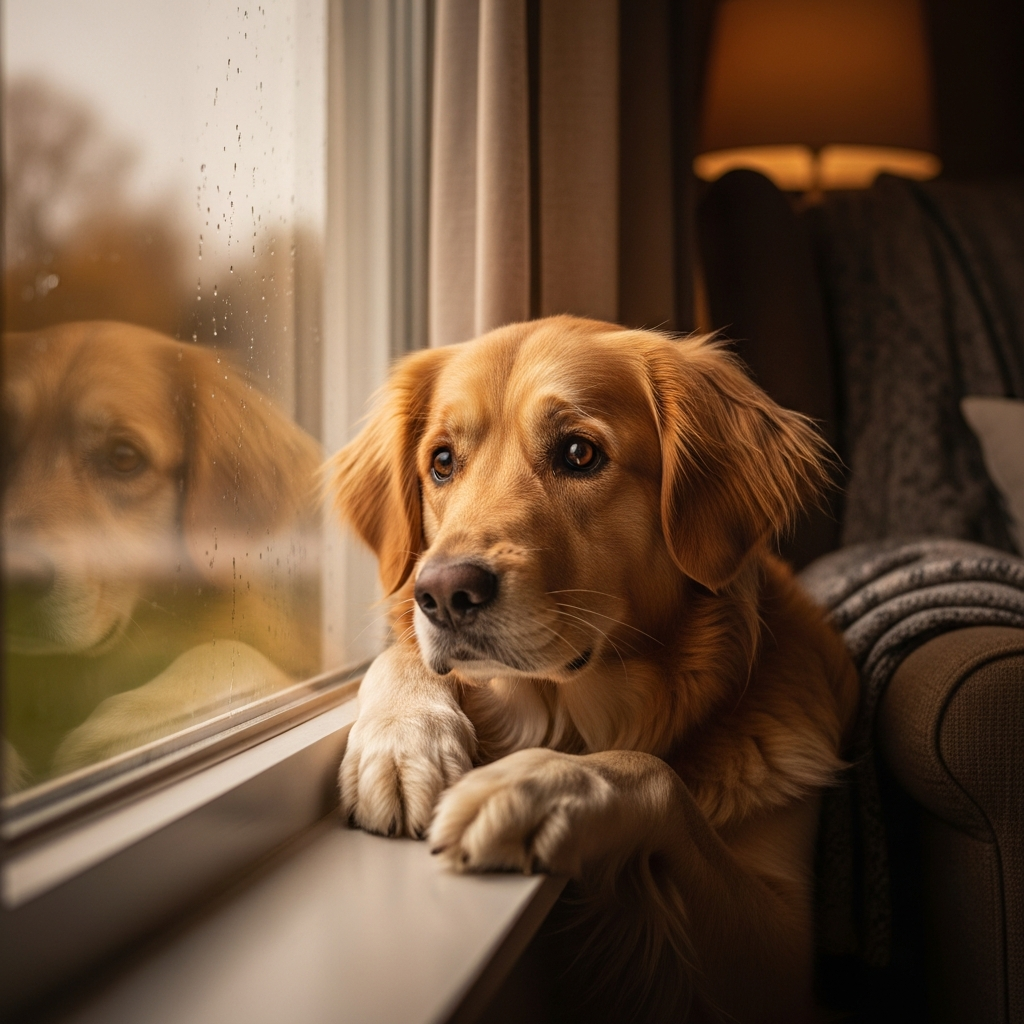
Your dog destroys the blinds when you leave. They howl for hours. They have chewed through a crate bar, scratched the paint off the front door, or urinated on the floor even though they are fully housetrained. You have tried everything - more exercise, puzzle toys, calming music, that pheromone diffuser - and nothing works.
If this sounds familiar, your dog may have separation anxiety. And I want to start with the most important thing you need to hear: your dog is not being spiteful. They are not punishing you for leaving. They are experiencing genuine panic - a fear response as real and overwhelming as a panic attack in a human.
Separation anxiety is one of the most heartbreaking behavior problems in dogs, and it is also one of the most misunderstood. The internet is full of advice that ranges from useless to harmful - “just ignore the crying,” “make them tough it out,” “they will get used to it.” That approach does not work. It makes things worse.
This guide gives you a practical, evidence-based plan. We will cover how to identify true separation anxiety, walk through a systematic desensitization protocol, discuss when medication is appropriate, and help you distinguish between anxiety and boredom (because the solutions are completely different).
For the full training philosophy behind everything in this article, visit our complete dog training guide.
Is It Actually Separation Anxiety?
Not every dog who destroys things when left alone has separation anxiety. There are several reasons dogs behave badly when their owner is gone, and the treatment depends on the cause.
True Separation Anxiety
Signs:
- Destruction focused on exit points (doors, windows, crate bars)
- Vocalization that begins immediately when you leave and does not stop
- Urination or defecation despite being fully housetrained
- Excessive drooling, panting, or pacing before you leave
- Self-injury (broken nails, torn gums, bloody paws from scratching)
- Symptoms occur every time you leave, not just sometimes
- Your dog follows you from room to room and becomes distressed when they cannot see you
The key distinction: True separation anxiety is a panic response triggered by your absence. It is not about being bored or under-exercised. A dog with true separation anxiety would rather stare at the door waiting for you than play with the most exciting toy in the world.
Boredom and Under-Stimulation
Signs:
- Destruction of random household items (shoes, pillows, trash cans) - not focused on exits
- Behavior is worse on days with less exercise
- Your dog settles eventually (maybe after 30-60 minutes of restless behavior)
- Providing a stuffed Kong or puzzle toy significantly reduces the problem
- Your dog is fine in some alone situations (e.g., when another dog is present)
If this sounds more like your dog, the solution is enrichment and exercise, not the anxiety protocol below. Head to our guide on how to entertain a bored dog and invest in interactive toys that keep their brain busy.
Isolation Distress vs. Separation Anxiety
Some dogs are fine when left with any person or another dog, but panic when completely alone. This is isolation distress - the fear of being alone rather than the fear of being separated from one specific person. The distinction matters because isolation distress is often easier to manage (doggy daycare, a pet sitter, or getting a second dog can help).
True separation anxiety is about you. Your dog panics when you - their primary attachment figure - leave, even if other people or dogs are present.
How to Be Sure: The Camera Test
Set up a camera (a pet camera, an old phone with a video call, or a webcam) and film your dog when you leave. Watch the footage carefully.
A dog with true separation anxiety will show distress within minutes of your departure - pacing, panting, whining, howling, or attempting to escape. This behavior does not settle. It may temporarily decrease in intensity but does not resolve until you return.
A bored dog will be restless for a while and then settle - maybe on the couch, maybe by the window. They may chew something, but the overall energy is restless boredom, not panic.
The camera test removes all guesswork. Do this before starting any treatment plan.
What Causes Separation Anxiety?
There is no single cause. Separation anxiety appears to result from a combination of factors:
Genetics and temperament. Some dogs are genetically predisposed to anxiety. Breeds are not destiny, but some breeds (particularly those bred for close human partnership) may be more susceptible.
Changes in routine. A sudden shift - new work schedule, moving to a new home, a family member leaving - can trigger separation anxiety in a previously stable dog.
Rehoming and shelter stays. Dogs who have been surrendered, abandoned, or have gone through multiple homes are at higher risk. The experience of losing an attachment figure can create deep insecurity about future departures.
Traumatic experiences while alone. A thunderstorm, a break-in, a fire alarm - if something frightening happened while your dog was home alone, they may associate being alone with danger.
Pandemic puppies. Dogs who were raised during the 2020-2021 lockdowns and spent their formative months with their owners home 24/7 may never have learned that alone time is normal and safe.
Understanding the cause helps you approach the problem with compassion, but the treatment is the same regardless of the trigger.
The Desensitization Protocol
Desensitization is the gold standard treatment for separation anxiety. The concept is straightforward: you systematically teach your dog that your departure predicts your return, starting with absences so short that they do not trigger anxiety and gradually increasing the duration.
This is not a quick fix. Depending on the severity, this protocol takes weeks to months. But it works.
Pre-Protocol: Reduce Absences
During the desensitization period, you need to minimize - ideally eliminate - full-length absences that trigger panic. Every time your dog has a full-blown anxiety episode, it reinforces the fear and sets back your progress.
Options for managing while you train:
- Work from home if possible
- Take your dog to doggy daycare
- Have a friend, family member, or pet sitter stay with your dog
- Use a dog-friendly workplace
I know this is the hardest part. Not everyone can avoid leaving their dog alone. Do the best you can. Even reducing panic episodes from daily to a few times per week makes a significant difference.
Step 1: Decouple Departure Cues
Your dog knows your routine. Keys jingling, shoes going on, grabbing your bag - these are departure cues that trigger anxiety before you even leave. You need to decouple these cues from actual departures.
How to do it:
- Pick up your keys, sit on the couch, put them down. Repeat randomly throughout the day.
- Put on your shoes and your jacket, then sit down and watch TV for 30 minutes.
- Grab your bag, walk to the door, then walk back and sit down.
- Open the front door, close it, and stay inside.
Do these exercises multiple times daily for at least a week. The goal is for your dog to see these cues and think, “This means nothing.” When the departure cues no longer trigger anxiety by themselves, you are ready for the next step.
Step 2: Micro-Departures
Start with departures so brief that your dog does not have time to become anxious.
- Walk to the door. Open it, step outside, immediately come back in. Mark and treat your dog for being calm. If your dog is calm, repeat.
- Step outside and close the door for one second. Open it, come back in, mark and treat.
- Gradually increase the duration outside the door: two seconds, five seconds, ten seconds, thirty seconds, one minute.
- Vary the duration randomly. Do not always go longer. After a thirty-second absence, do a five-second one. After one minute, do ten seconds. Randomness prevents your dog from anticipating and escalating.
Step 3: Short Absences
Once your dog can handle five minutes of absence without distress (watch on camera), you can start building toward functional absence durations.
- Leave for five minutes. Drive around the block if needed. Return calmly.
- Build to ten minutes, fifteen minutes, thirty minutes. Continue varying - some short, some longer.
- Watch the camera. If your dog shows stress signs (pacing, whining that does not settle within a few minutes), you went too far. Drop back to the last duration that was successful.
- Target thirty to forty-five minutes as your first major milestone. This is the hardest threshold. Once dogs can handle forty-five minutes, the next few hours often come relatively quickly - the initial departure is the worst part for most dogs.
Step 4: Functional Absences
Continue building duration: one hour, ninety minutes, two hours, three hours. By this point, progress usually accelerates. The pattern to maintain:
- Always vary durations within a session
- Always watch on camera
- Always go back a step if you see anxiety
- Always keep departures and arrivals low-key
Step 5: Real-World Proofing
Once your dog can handle four to six hours alone, start practicing in real-world conditions:
- Leave at different times of day
- Leave through different doors
- Leave with and without specific departure cues (keys, bag)
- Leave when your dog is in different rooms
- Vary what your dog has access to (crate, one room, whole house)
What to Do During Departures
Even while working through the protocol, there are things you can do to make departures easier.
Keep Arrivals and Departures Low-Key
Do not make a dramatic goodbye or an ecstatic reunion. Both increase your dog’s emotional arousal around departures. Leave calmly and return calmly. Save the love for five minutes after you get home, once your dog has settled.
Provide a High-Value Departure Cue
Give your dog something amazing that they only get when you leave. A frozen Kong stuffed with peanut butter and kibble, a long-lasting chew, or a snuffle mat. This creates a positive association with your departure and provides a distraction during the critical first few minutes.
Important note: Dogs with severe separation anxiety may not eat anything when you are gone. This is actually a diagnostic indicator - a dog too anxious to eat when alone is truly in distress. If your dog ignores food in your absence, focus on the desensitization protocol before relying on food-based strategies.
Exercise Before You Leave
A tired dog is calmer. A good walk or play session thirty minutes before you leave can take the edge off. But exercise alone does not fix separation anxiety - think of it as one piece of the puzzle, not the whole picture.
Create a Calming Environment
- Leave the TV or radio on at a normal volume (not something you only turn on when leaving)
- Close blinds if your dog reacts to visual stimuli outside
- Provide a comfortable resting spot in a room where your dog feels safe
When to Talk to Your Vet About Medication
Medication is not a failure. For moderate to severe separation anxiety, medication can be the difference between a protocol that works and one that does not.
When Medication Makes Sense
- Your dog’s anxiety is so severe that they cannot learn (they are over threshold immediately)
- Your dog is injuring themselves during absences
- The desensitization protocol has been followed consistently for four to six weeks with little progress
- Your living situation does not allow you to fully manage absences during training
Types of Medication
Daily anti-anxiety medication (SSRIs like fluoxetine, or TCAs like clomipramine): These take three to six weeks to reach full effect and are given daily. They lower your dog’s baseline anxiety, making the desensitization protocol more effective. They do not sedate your dog - they reduce the panic response.
Situational medication (trazodone, gabapentin, or benzodiazepines): These are given before specific stressful events and take effect within one to two hours. They can be used during the training period for unavoidable absences.
Medication works best in combination with behavioral modification. Pills alone rarely resolve separation anxiety. But pills plus the desensitization protocol often produce results that neither could achieve alone.
Talk to your veterinarian or a veterinary behaviorist about the right approach for your dog. For a broader look at anxiety in dogs - including general anxiety, noise phobia, and more - see our dog anxiety health guide.
Supplements and Calming Products
The market is flooded with calming products. Here is an honest assessment:
Adaptil (DAP) diffusers and collars: These release a synthetic version of the pheromone nursing dogs produce. Research is mixed - some studies show modest benefit, others show none. Worth trying as a low-risk supplement to behavioral work.
Calming supplements (L-theanine, alpha-casozepine): Some dogs respond to these. They are generally safe but unlikely to resolve true separation anxiety on their own. Think of them as taking the edge off, not solving the problem.
ThunderShirt/pressure wraps: These provide gentle, constant pressure that some dogs find calming. Works well for mild anxiety. Unlikely to help severe separation anxiety.
CBD products: Research in dogs is limited. Quality control in the market is poor. If you want to try this route, discuss it with your vet first.
None of these replace the desensitization protocol. They may support it.
Crate Training and Separation Anxiety
A common question: should you crate a dog with separation anxiety?
It depends. Some dogs with mild separation anxiety feel more secure in a crate - the enclosed space mimics a den and reduces their world to a manageable size. These dogs are calmer in a crate than loose in the house.
Other dogs experience confinement anxiety on top of separation anxiety. The crate makes them panic more, not less. These dogs may injure themselves trying to escape.
How to tell: Set up a camera and compare your dog’s behavior in the crate vs. loose in one room. If they are calmer in the crate, use it. If they are more distressed, skip the crate and use baby gates to confine them to a safe room instead.
Never force a dog with separation anxiety into a crate. If crating causes more distress, it is contraindicated.
Common Mistakes in Treating Separation Anxiety
“Just Let Them Cry It Out”
This does not work for true separation anxiety. Flooding (forcing prolonged exposure to the fear trigger) is not an effective treatment for panic disorders in dogs or humans. It often makes the anxiety worse and can lead to learned helplessness - your dog may stop vocalizing but the internal panic remains.
Punishment
Punishing your dog for destruction, elimination, or vocalization that occurred while you were gone is pointless and harmful. Your dog cannot connect the punishment to something they did hours ago. All they learn is that your return is unpredictable and sometimes scary - which makes the anxiety worse.
Getting a Second Dog as a Fix
If your dog has true separation anxiety (attachment to you, not isolation distress), a second dog will not help. Your dog does not panic because they are alone - they panic because you are gone. A second dog changes nothing about that equation and now you have two dogs to manage.
If your dog has isolation distress (panic about being alone, regardless of who is gone), a second dog may help. The camera test can clarify which situation you are dealing with.
Inconsistent Protocol
The desensitization protocol requires consistency. Doing micro-departures three days a week while leaving for eight hours the other four days does not work. Every panic episode sets back progress. If you cannot commit to the protocol fully, enlist help (daycare, pet sitters) to cover the gaps.
When to Seek Professional Help
Separation anxiety exists on a spectrum. Mild cases often respond well to the protocol above within a few weeks. Moderate to severe cases may need:
- A Certified Separation Anxiety Trainer (CSAT). These trainers specialize exclusively in separation anxiety and work with you remotely (via camera footage) to customize the protocol for your dog.
- A Veterinary Behaviorist (Diplomate ACVB). These are veterinarians with advanced training in behavior. They can prescribe medication and create a comprehensive behavior modification plan.
- A Certified Applied Animal Behaviorist (CAAB or ACAAB). PhD-level behaviorists who can design and oversee complex treatment plans.
Seek help immediately if your dog is injuring themselves, if your housing is at risk (noise complaints, property damage), or if you have been working the protocol consistently for six weeks with no improvement.
Frequently Asked Questions
How long does it take to fix separation anxiety?
Mild cases may resolve in two to four weeks with consistent desensitization. Moderate cases typically take two to four months. Severe cases can take six months or longer and often require medication alongside behavioral work. The timeline depends on severity, your consistency, and whether you can manage absences during training.
Will my dog grow out of separation anxiety?
Generally, no. Separation anxiety does not resolve on its own. Without intervention, it typically stays the same or worsens over time. The good news is that with proper treatment, the prognosis is good - most dogs improve significantly.
Is separation anxiety more common in certain breeds?
Some studies suggest higher rates in herding breeds and breeds with strong attachment tendencies, but any breed (or mix) can develop separation anxiety. It is more about individual temperament, early experiences, and life events than breed.
Can I use a pet camera to check on my dog?
Absolutely - a camera is essential for this protocol. You need to see what your dog is doing when you are not there to calibrate your training correctly. However, do not use a two-way camera to talk to your dog during absences. Hearing your voice without your presence can increase anxiety for some dogs.
My dog only has separation anxiety when I leave but not my partner. Is that normal?
Yes. Separation anxiety is often attachment-specific. Your dog may be more bonded to you or may have had a negative experience related to your departures specifically. The treatment is the same - you are the one who needs to do the desensitization protocol.
Does daycare help with separation anxiety?
Daycare can be an excellent management tool during the training period because it prevents panic episodes. However, daycare alone does not treat separation anxiety - your dog still panics when left alone at home. Use daycare to manage while you work the desensitization protocol.
My dog is fine during the day but panics at night. What is going on?
Nighttime anxiety can look like separation anxiety but may also involve noise sensitivity, changes in household routine, or simple discomfort. Try keeping your dog in your bedroom at night. If that resolves it, the issue is likely isolation distress rather than true separation anxiety. If nighttime panic persists even when you are in the room, consult your vet - there may be a medical component.