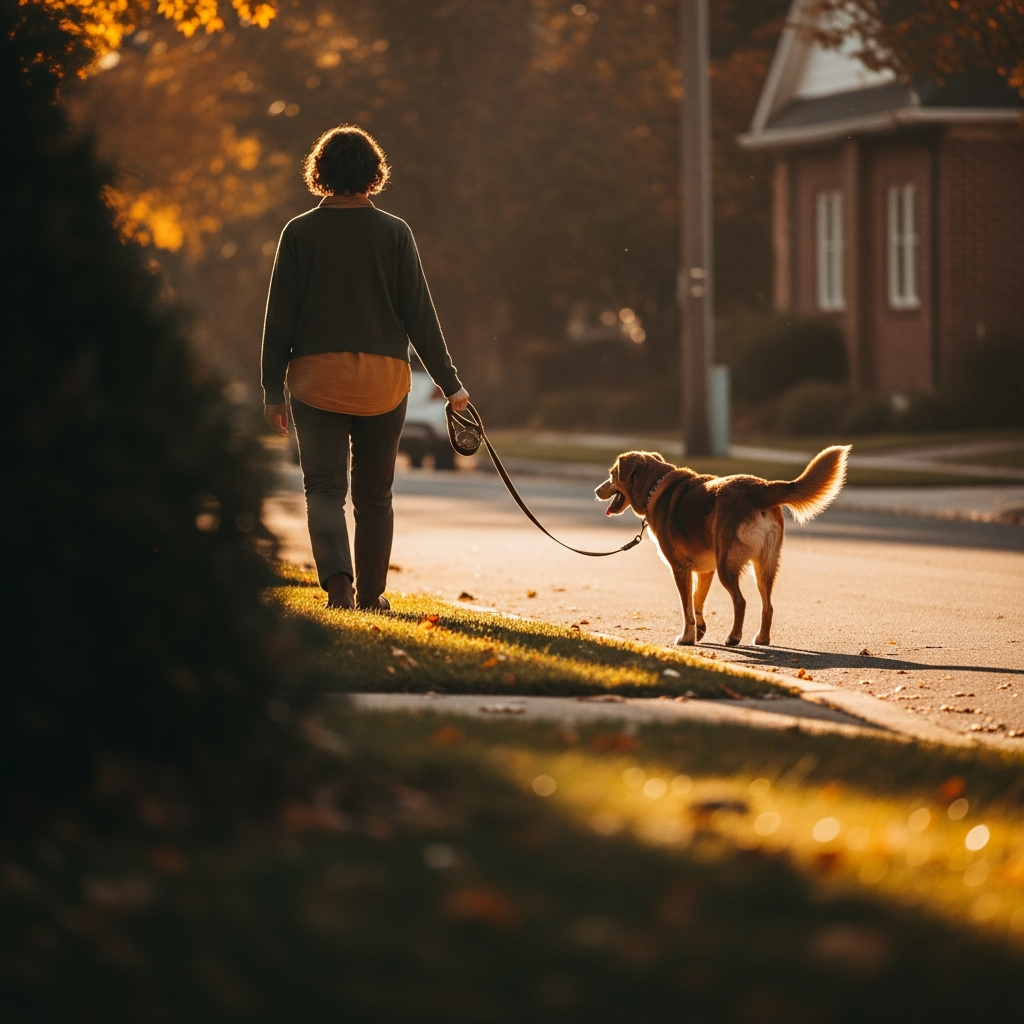
If your walks look more like a sled dog competition than a stroll through the neighborhood, you are not alone. Leash pulling is the most common complaint dog owners have - and it is also one of the most fixable.
Here is the uncomfortable truth: your dog pulls because pulling works. Every time they strain against the leash and still move forward, they learn that pulling equals progress. You have been accidentally reinforcing the exact behavior you want to stop.
The good news? You can reverse this. With the right technique, the right equipment, and two to four weeks of consistent practice, your dog can learn that a loose leash is the only way to move forward.
This guide covers three proven techniques - the be-a-tree method, direction changes, and engagement training - plus the equipment that supports your training rather than replacing it. No prong collars, no shock collars, no shortcuts that create new problems.
For the broader training framework behind everything here, check out our complete dog training guide.
Why Dogs Pull on the Leash
Dogs do not pull to dominate you. They pull because they are excited, the world is fascinating, and walking at human speed is agonizingly slow for an animal that can sprint at 20+ miles per hour.
Think about it from your dog’s perspective. There are a thousand smells to investigate, squirrels to watch, other dogs to meet, and grass to roll in - and you want them to walk at your pace in a straight line. That is a big ask.
Pulling is also self-reinforcing. Every time your dog pulls and gets where they want to go, they learn: “I pull, I get to the bush. I pull, I get to the other dog. Pulling works.” You need to break that reinforcement loop.
Understanding the why helps you approach the solution with patience rather than frustration. Your dog is not being bad. They are being a dog. Your job is to teach them that a loose leash is the only way to access the things they want.
Equipment: Set Your Dog Up for Success
Before we get into technique, let us talk about equipment. The right gear does not replace training, but it makes training dramatically easier.
Use a Front-Clip Harness
A no-pull harness with a front chest clip is the gold standard for leash training. When your dog pulls, the front attachment point redirects them back toward you rather than allowing them to lean into the leash with their full body weight.
This is not a fix on its own - it is a training tool. Your dog will still need to learn loose leash walking. But a front-clip harness makes the process faster and more comfortable for both of you.
Use a Standard 6-Foot Leash
A 6-foot flat leash gives your dog enough room to walk comfortably without so much slack that they can build momentum before hitting the end. Check out our best dog leash guide for specific recommendations.
Do not use a retractable leash. Retractable leashes teach your dog that the leash length is variable and that pulling extends it. That is the exact opposite of what you want.
Skip the Aversive Equipment
Prong collars, choke chains, and shock collars suppress pulling through pain. The dog does not learn to walk politely - they learn that pulling hurts. This distinction matters because:
- The behavior often returns when the aversive equipment is removed
- Aversive tools can create negative associations with walks, other dogs, and people
- They can cause physical injury, especially to the trachea and neck
You do not need them. The techniques below work without causing pain or fear.
Technique 1: The Be-a-Tree Method
This is the simplest and most effective technique for most dogs. The concept is straightforward: when the leash gets tight, you stop. When the leash is loose, you walk.
How It Works
Start walking. Hold the leash in both hands (one hand anchoring at your hip, the other managing slack) and begin walking at your normal pace.
The instant the leash gets tight, stop completely. Do not pull back, do not say anything, do not move. Just stop. Plant your feet like a tree.
Wait. Your dog will probably look at you, look around, sniff the ground, maybe look at you again. At some point, they will take a step back, turn toward you, or create slack in the leash.
The moment the leash goes slack, mark and move forward. Say “yes” (or click) and immediately start walking again. Forward movement is the reward.
Repeat. Every single time the leash gets tight, you stop. Every time it goes slack, you walk. No exceptions.
Why It Works
This technique works because it directly breaks the reinforcement loop. Your dog learns: “When I pull, everything stops. When the leash is loose, we go.” The reward (forward movement) is directly connected to the desired behavior (loose leash).
What to Expect
Days 1-3: Your walks will be painfully slow. You might cover one block in twenty minutes. This is normal and necessary. Do not get frustrated - this is the investment phase.
Days 4-7: You will notice your dog checking in more frequently. They will start to anticipate the stop and may auto-correct before the leash gets tight. This is a huge milestone.
Weeks 2-3: Pulling episodes decrease significantly. Your dog walks with more awareness of the leash. You can cover more ground.
Week 4 and beyond: Loose leash walking becomes the default. You will still have occasional lapses (especially around high-value distractions), but the overall pattern is dramatically different.
Tips for Success
- Be 100% consistent. If you stop for pulling sometimes but not others, your dog learns that pulling sometimes works - which is actually harder to extinguish than pulling that always works. Every pull, every stop.
- Keep your first sessions short. Ten to fifteen minutes is plenty. The mental effort of learning this is tiring for your dog.
- Walk in low-distraction areas first. A quiet residential street is better than a busy park for the first week.
- Bring high-value treats. Periodically reward your dog for checking in with you or walking by your side, even if the leash is not tight. This reinforces the position you want.
Technique 2: Direction Changes
Direction changes add a layer of unpredictability that keeps your dog focused on you rather than on what is ahead.
How It Works
Walk normally until your dog gets ahead of you and the leash tightens.
Without saying anything, turn and walk in the opposite direction. Not a slow, gentle turn - a clear, decisive 180-degree turn.
Your dog will feel the leash tension change and turn to follow you. The moment they catch up and the leash is loose, mark and treat.
Continue walking in the new direction. If they get ahead and pull again, turn again.
After several repetitions, add a verbal cue. Before turning, say “this way” in an upbeat voice. Over time, your dog will learn to turn with you on cue.
Why It Works
Direction changes teach your dog that forging ahead is pointless because the destination keeps changing. The only way to predict where you are going is to pay attention to you. This naturally shifts your dog’s focus from the environment to you.
When to Use Direction Changes vs. Be-a-Tree
Use direction changes for dogs who are very intense pullers and do not respond quickly to the be-a-tree method. If your dog pulls and you stop, and they just stand at the end of the leash staring at the thing they want for minutes at a time, direction changes are more effective because they break the dog’s focus on the distraction.
Many trainers combine both techniques: stop first, and if the dog does not re-engage within five seconds, turn and walk the other way.
Technique 3: Engagement Training
Engagement training is the most proactive of the three techniques. Instead of only responding to pulling, you actively reward your dog for being in the position you want.
How It Works
Before you start walking, get your dog’s attention. Say their name or use a “watch me” cue. When they look at you, mark and treat.
Take a few steps. While your dog is walking near you (within arm’s reach, leash loose), mark and treat. Deliver the treat at your side, at your dog’s nose level. This teaches them that being near your leg is where the good things happen.
Vary your pace and direction. Walk faster, walk slower, turn left, turn right. Each time your dog adjusts to stay with you, mark and treat.
Gradually reduce the frequency of treats as your dog starts defaulting to the loose leash position. Move from treating every few steps to every ten steps, then every thirty, then randomly.
Why It Works
Engagement training works because it teaches your dog what to do rather than only correcting what not to do. Your dog learns that the magic spot - right next to you with a loose leash - is the most rewarding place to be.
This technique is especially effective for dogs who are motivated by connection and play, not just food. An engaged dog who is having fun walking with you has no reason to pull ahead.
Combining All Three Techniques
The most effective approach uses all three together:
- Engagement training is your proactive tool. Use it to reward loose leash walking and build a habit of walking near you.
- Be-a-tree is your reactive tool for mild pulling. Stop when the leash tightens, resume when it relaxes.
- Direction changes are your reactive tool for intense pulling. When your dog is locked onto something and will not disengage, change direction to break their focus.
The Biggest Mistakes People Make
Inconsistency
This is the number one reason leash training fails. You stop when they pull on training walks, but then you are running late so you just let them drag you to the car. Or you are consistent during the week but your partner lets them pull on weekends. Every time pulling succeeds, you erase some of your progress.
If you cannot do a training walk, use management instead - a front-clip harness, a shorter leash, or even driving to your destination. Do not practice the behavior you are trying to eliminate.
Pulling Back on the Leash
When your dog pulls, the natural instinct is to pull back. Resist this. Pulling back creates an opposition reflex - your dog will actually pull harder in response. Instead, stop moving or change direction. Let the technique do the work.
Yanking or Jerking the Leash
Leash corrections (sharp jerks on the leash) are a punishment-based technique that erodes trust and can injure your dog’s neck. They also do not teach your dog what you want them to do - they only tell them what hurts. Skip this entirely.
Expecting Results Too Fast
Leash pulling is a deeply ingrained habit for most dogs. They have been doing it for months or years. It takes two to four weeks of consistent practice to see significant change, and several months for the new behavior to become truly habitual. Be patient.
Only Training on “Training Walks”
Every walk is a training walk during the learning phase. If you do ten-minute training walks but let your dog pull during thirty-minute “real” walks, your dog will not distinguish between the two. Consistency on every walk is what creates change.
Troubleshooting Common Problems
My dog is great on leash until they see another dog or a squirrel.
This is a threshold issue. Your dog can walk politely when the distractions are below a certain level, but specific triggers blow past their ability to focus. Work on increasing distance from the trigger. If your dog loses it when a squirrel is ten feet away, practice at forty feet and gradually close the gap as your dog’s focus improves. Pair this with socialization training if the trigger is other dogs.
My dog pulls at the start of every walk and then settles down.
This is excitement-based pulling. Your dog is so amped about the walk that they cannot think clearly for the first few minutes. Two solutions: first, do a quick training session (sit, down, sit, down) before you leave the house to channel some of that energy. Second, practice the be-a-tree method right outside your door - do not let the walk truly begin until your dog is walking on a loose leash.
My dog walks perfectly on one side but pulls on the other.
Your dog has learned the rules for one position but has not generalized them. Practice on the pulling side with the same techniques you used initially. Start from scratch - it usually goes faster the second time.
It has been three weeks and I am not seeing improvement.
Check your consistency. Are you stopping every single time? Is everyone in the household doing the same thing? Are you using the right equipment? If the answer to all of these is yes and you still are not seeing progress, consider booking a session with a positive reinforcement trainer who can watch your technique in person and offer adjustments.
My small dog pulls more in a harness than a collar.
Some small dogs do pull harder in a harness because they can lean into it comfortably. Make sure you are using a front-clip harness, not a back-clip harness. Back-clip harnesses actually encourage pulling because the attachment point is between the shoulder blades - right where sled dogs are hitched. A front-clip redirects the pulling force instead of enabling it.
How to Maintain Loose Leash Walking
Once your dog is walking well on leash, you need to maintain it. Here is how:
- Continue to reward periodically. You can fade treats, but do not eliminate them entirely. A random treat every few minutes keeps the behavior strong.
- Use life rewards. “You want to sniff that bush? Walk nicely to it.” Access to the things your dog wants is a powerful reinforcement tool.
- Stay consistent. Even after months of good behavior, one week of inconsistency can bring pulling back. The rules do not change.
- Expect setbacks. New environments, high-distraction situations, and adolescence (if your dog is young) will test your training. Go back to basics when needed.
For a complete set of basic commands that support leash training - especially “leave it” and “watch me” - head to our commands guide. And for the full training philosophy and framework, visit our complete dog training guide.
Frequently Asked Questions
How long does it take to stop a dog from pulling on leash?
Most dogs show significant improvement within two to four weeks of consistent training. However, the behavior becoming truly automatic can take two to three months. The key variable is consistency - if you stop every time your dog pulls on every walk, progress is fast. If you are inconsistent, it takes much longer.
Can I train an older dog to stop pulling?
Absolutely. Older dogs may have a more ingrained pulling habit, but they can also focus better and often pick up the new pattern quickly once they understand the rules. The techniques are identical regardless of age.
Is a harness better than a collar for leash training?
For most dogs, yes. A front-clip no-pull harness reduces pulling mechanically while you train the behavior. A collar puts all the pressure on your dog’s neck, which can cause injury - especially in dogs who pull hard.
Should I use a head halter?
Head halters (like the Gentle Leader or Halti) work well for some dogs but are not universally loved. Some dogs find them aversive and spend the entire walk pawing at their face. If your dog tolerates one, it can be an effective management tool during training. But it is not a replacement for teaching loose leash walking - when you remove the head halter, the pulling returns unless you have also done the training.
What about off-leash walking?
Off-leash walking is a separate skill that requires a bombproof recall first. Work through our basic commands guide - specifically the recall section - and only consider off-leash walking when your dog responds to “come” reliably in high-distraction environments. Even then, only in legal off-leash areas.
My dog walks well for my partner but pulls with me. Why?
Your dog has learned different rules with different people. Whoever the dog pulls with is likely less consistent - maybe they allow pulling sometimes, use a different technique, or walk at a faster pace that inadvertently rewards forward motion. Get on the same page with your partner about technique and consistency. Your dog is not choosing favorites; they are responding to different reinforcement histories.
Can I use treats on every walk or will my dog become treat-dependent?
You should use treats heavily during the learning phase (first two to four weeks). After that, gradually reduce them. Move to variable reinforcement - treat randomly rather than every time. Incorporate life rewards (access to sniffing, greeting other dogs, exploring). Your dog will not become “treat-dependent” any more than you would become “paycheck-dependent” - but you would not work for free either. Some form of reward should always be part of the picture.