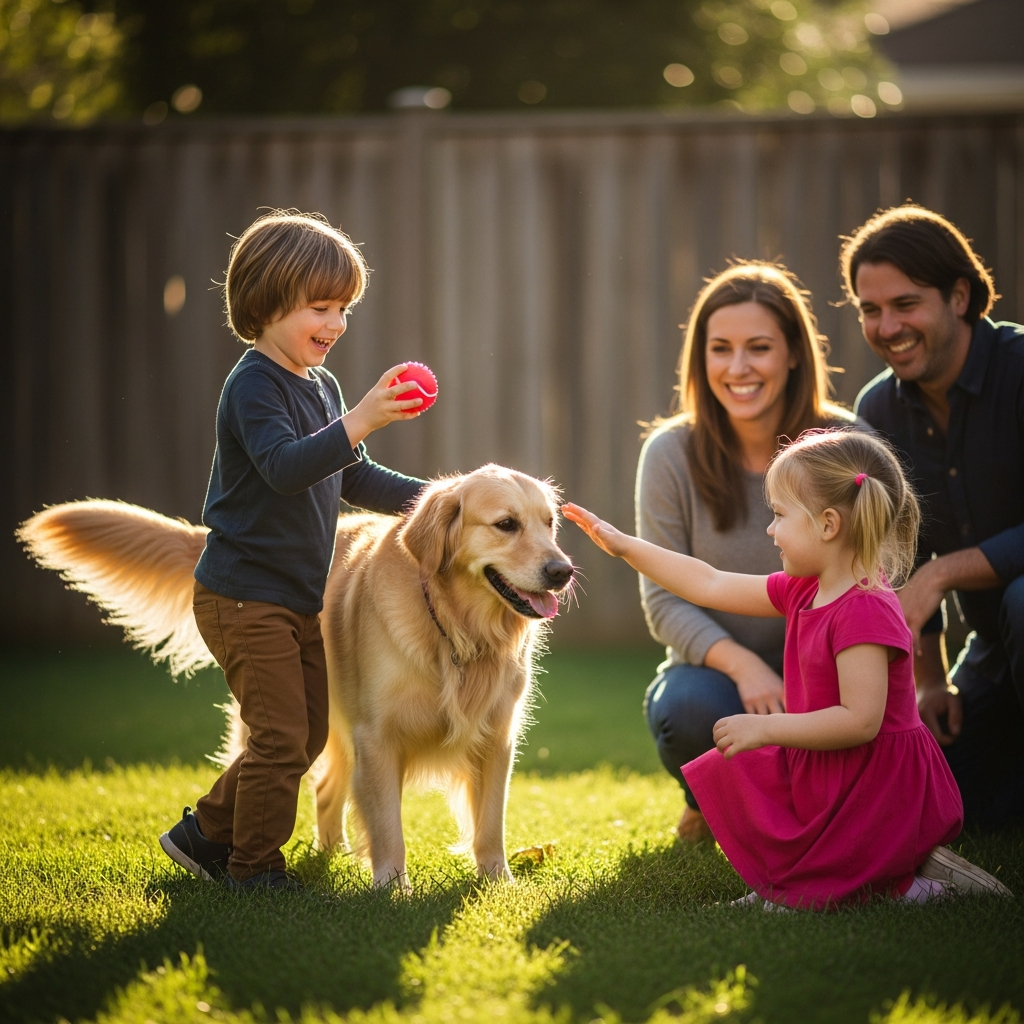
Choosing a dog for your family is different from choosing a dog for yourself. When kids are in the picture, temperament matters more than aesthetics, patience matters more than athleticism, and the margin for error shrinks considerably.
A family dog needs to tolerate unpredictable behavior – grabbing, loud noises, sudden movements, the occasional accidental tail pull from a toddler who doesn’t know better yet. Not every breed handles that well, and pretending otherwise does a disservice to both the dog and the child.
This guide ranks 10 breeds based on the traits that actually matter for families with children: gentleness, trainability, tolerance of chaos, energy compatibility, and overall reliability around small humans.
What Makes a Good Family Dog
Tolerance and Patience
Children are unpredictable. They drop things, they scream, they run, they grab, and they invade personal space. A good family dog has a high tolerance threshold – the point at which they become stressed, fearful, or reactive is far above what a typical child will trigger.
No dog has infinite tolerance. Every dog can be pushed past their limit. The goal is a breed with a naturally high threshold combined with proper socialization and training.
Trainability
A dog that learns rules quickly is safer around children. Trainable breeds respond well to basic commands like “leave it,” “stay,” and “gentle” – commands that directly protect kids during daily interactions.
Energy Match
The right energy level depends on your kids’ ages. Toddler families often do better with calm, patient breeds. Families with school-age kids who play outside for hours may want a dog with matching energy. Mismatched energy – a hyperactive dog with a cautious child, or a sedentary dog with an energetic child who wants a running partner – creates frustration for everyone.
Size Considerations
Very small dogs (under 10 pounds) can be injured by young children who don’t understand gentle handling. Very large dogs (over 100 pounds) can knock toddlers over without meaning to. Medium to large breeds (30-80 pounds) tend to be the sweet spot for families with small children.
Predictability
Families need dogs with stable, predictable temperaments. Breeds with known reactivity issues, extreme prey drive, or high variability in temperament from dog to dog are riskier choices when children are involved.
The 10 Best Dog Breeds for Families With Kids
1. Golden Retriever
Size: 55-75 lbs | Energy: Moderate-High | Trainability: Excellent | Kid Tolerance: Exceptional
There’s a reason the Golden Retriever is the default family dog recommendation. They’re gentle, patient, eager to please, and genuinely enjoy the company of children. Their trainability makes them responsive to household rules, and their soft mouth (bred for retrieving game birds without damaging them) translates to naturally gentle play.
The honest truth: Goldens shed. A lot. Constantly. Your house will have tumbleweeds of golden fur no matter how often you brush. They’re also prone to cancer – the breed has one of the highest cancer rates among all dogs, with studies suggesting up to 60% of Goldens develop some form. Hip dysplasia, elbow dysplasia, and heart disease are also concerns. Budget for regular vet care and consider health insurance early.
Exercise needs: 60-90 minutes of daily activity. They love fetch, swimming, and hiking. A Golden without enough exercise becomes mouthy, jumpy, and destructive. With enough exercise, they’re the calmest, most accommodating house dog you’ll find.
Best for: Active families with a yard. Families with kids ages 3 and up. Homes where shedding isn’t a dealbreaker.
2. Labrador Retriever
Size: 55-80 lbs | Energy: High | Trainability: Excellent | Kid Tolerance: Exceptional
Labs share the Golden’s family-friendly temperament with even higher energy. They’re the most popular breed in America for good reason – they’re versatile, trainable, social, and built for an active household.
The honest truth: Labs are puppies until they’re 3 years old. That extended adolescence means a large, exuberant dog that jumps, mouths, and body-slams furniture for longer than most breeds. Training and exercise management during the first two years is critical. They also eat everything – food, non-food, and things that probably shouldn’t exist. Obstruction surgeries from swallowed objects are disproportionately common in Labs. They shed heavily, and they’re prone to obesity if their food intake isn’t carefully managed.
Exercise needs: 60-120 minutes daily. Labs need more exercise than Goldens and are more likely to develop behavioral problems if under-exercised. Swimming, fetch, and running are ideal.
Best for: Highly active families with outdoor space. Families who want a dog that participates in every activity. Homes prepared for the exuberant puppy phase that lasts 2-3 years.
3. Beagle
Size: 20-30 lbs | Energy: Moderate-High | Trainability: Moderate | Kid Tolerance: High
Beagles are sturdy, cheerful, and built to play. Their medium size means they’re big enough to tolerate rough play from kids without getting hurt, and small enough that they can’t accidentally knock a toddler across the room.
The honest truth: Beagles bark. And howl. Their “arooo” is charming for about two days before it becomes a neighborhood event. They’re also nose-driven to a fault – once they pick up a scent, they become deaf to commands. Off-leash reliability is poor in most Beagles. They’re food-motivated, which helps with training, but it also means they’ll raid trash cans, counters, and backpacks with impressive determination.
Exercise needs: 45-60 minutes daily. Walks, yard play, and especially scent work (hide treats around the house or yard) satisfy their mental and physical needs.
Best for: Families with school-age kids who want a medium-sized playmate. Homes with a fenced yard (Beagles follow their noses through open doors). Families who can handle the vocalization.
4. Cavalier King Charles Spaniel
Size: 12-18 lbs | Energy: Low-Moderate | Trainability: Good | Kid Tolerance: High
The Cavalier is gentle by design. They’re naturally sweet, adaptable, and content to match whatever energy level is happening around them. With kids, they’re patient and affectionate without being overwhelming.
The honest truth: The health concerns covered in our apartment breeds guide apply here too – mitral valve disease and syringomyelia are significant breed concerns. Their small size also means toddlers need close supervision to prevent rough handling. Cavaliers are fragile compared to the larger breeds on this list.
Exercise needs: 30-40 minutes daily. Two moderate walks and some indoor play. They’re not demanding and won’t require a rigorous exercise commitment.
Best for: Calmer families, families with gentle older children, or homes where the kids want a lap dog that also enjoys playing. First-time dog owners who want a forgiving, easy-going breed.
5. Labradoodle / Goldendoodle
Size: 30-65 lbs (varies widely) | Energy: Moderate-High | Trainability: Good-Excellent | Kid Tolerance: High
Doodle mixes combine the family-friendly temperament of retrievers with the low-shedding coat of Poodles. When the genetics work as intended, you get a friendly, trainable, allergy-friendlier family dog.
The honest truth: Doodles are mixed breeds, and mixed-breed traits are variable. There’s no guarantee on coat type (some shed significantly), size, or temperament. The “hypoallergenic” label is misleading – no dog is truly hypoallergenic, and some Doodles shed as much as their retriever parent. The breed’s popularity has also attracted irresponsible breeders. If you go this route, vet your breeder carefully – health testing, temperament testing, and transparency about parent dogs are non-negotiable. See our rescue vs. breeder guide for vetting criteria.
Exercise needs: 45-90 minutes daily, depending on size and energy level. They’re active dogs that need both physical exercise and mental stimulation.
Best for: Allergy-conscious families who want a retriever temperament with (potentially) less shedding. Active families willing to research breeders thoroughly or adopt from Doodle-specific rescues.
6. Boxer
Size: 50-80 lbs | Energy: High | Trainability: Moderate-Good | Kid Tolerance: Excellent
Boxers are the clowns of the dog world, and kids love them for it. They’re playful, goofy, patient, and protective of their family without being aggressive. Their natural play style – bouncy, exuberant, physical – matches the energy of children better than almost any other breed.
The honest truth: Boxers are high-energy and need consistent training to channel their enthusiasm. An untrained Boxer is a 70-pound bouncing ball that will knock over small children simply by being excited. They’re also a brachycephalic breed (though less extreme than Bulldogs or Pugs), so heat tolerance is limited. Cancer rates are high, and their average lifespan is 10-12 years.
Exercise needs: 60-90 minutes daily. They need active play, not just walks. Fetch, tug-of-war, and running in the yard are ideal. They slow down significantly after age 5-6.
Best for: Active families with school-age kids who want a dog that matches their energy. Homes with yards. Families who appreciate a dog with personality and don’t mind the goofiness.
7. Collie (Rough and Smooth)
Size: 50-75 lbs | Energy: Moderate | Trainability: Excellent | Kid Tolerance: Exceptional
The Collie – think Lassie – is one of the most naturally gentle, child-oriented breeds in existence. They’re intelligent, responsive, and have an almost instinctive awareness of children in their care. Some Collies will gently herd children away from perceived dangers, which is both endearing and useful.
The honest truth: Rough Collies require significant grooming – their coat needs brushing several times a week and mats easily. Smooth Collies need much less maintenance. They can be sensitive and reactive to raised voices, which means a chaotic household with a lot of yelling may stress them out. They’re prone to Collie eye anomaly (a genetic eye condition) and MDR1 gene sensitivity (which makes certain common medications dangerous).
Exercise needs: 45-60 minutes daily. They enjoy walks, moderate play, and especially any activity that engages their brain. They don’t need intense physical exercise but do need mental stimulation.
Best for: Families who want a gentle, attentive, intelligent dog. Homes willing to commit to grooming (Rough Collie) or who prefer the low-maintenance Smooth Collie coat. Great for first-time families.
8. Irish Setter
Size: 60-70 lbs | Energy: High | Trainability: Good | Kid Tolerance: High
Irish Setters are gorgeous, enthusiastic, and endlessly affectionate. They approach life with a joyful exuberance that’s contagious, and they’re naturally drawn to children.
The honest truth: Irish Setters are slow to mature mentally. You’ll have a puppy brain in a full-sized adult body until about age 3. They need substantial exercise and don’t handle boredom well – an under-exercised Irish Setter will find creative (destructive) ways to entertain themselves. Their long coat needs regular grooming, and they’re prone to bloat (gastric torsion), which is a life-threatening emergency that requires immediate surgery.
Exercise needs: 60-90 minutes of vigorous daily activity. Running, hiking, and off-leash play in safe areas. They’re athletic dogs that need to move.
Best for: Very active families who spend time outdoors. Families with older kids who can participate in exercising the dog. Homes with a yard and an active lifestyle.
9. Bernese Mountain Dog
Size: 70-115 lbs | Energy: Moderate | Trainability: Good | Kid Tolerance: Exceptional
The Bernese Mountain Dog is a gentle giant with a naturally calm, patient disposition around children. They’re affectionate without being needy, sturdy enough for rough play, and their big, goofy personality endears them to every member of the family.
The honest truth: The Bernese Mountain Dog has one of the shortest lifespans of any breed – 6-8 years on average. Cancer, particularly histiocytic sarcoma, is devastatingly common. For families with young children, this means having a conversation about loss far sooner than with most breeds. They shed heavily, drool, and are expensive to maintain (more food, larger gear, higher vet bills). They also struggle in hot climates – their thick coat is built for Swiss Alps, not Texas summers.
Exercise needs: 30-60 minutes daily. They enjoy walks and moderate play but aren’t as demanding as retrievers or setters. Avoid intense exercise in warm weather.
Best for: Families who want a large, gentle companion and accept the shorter lifespan trade-off. Homes in cooler climates with space for a big dog. Families who value calm devotion over high-energy play.
10. Standard Poodle
Size: 40-70 lbs | Energy: Moderate-High | Trainability: Exceptional | Kid Tolerance: High
Don’t let the fancy haircuts fool you. Standard Poodles are athletic, intelligent, and versatile family dogs. They’re the second-smartest breed (behind Border Collies) and channel that intelligence into being responsive, trainable companions.
The honest truth: Poodles require professional grooming every 4-6 weeks, and the cost adds up. They can be sensitive and don’t respond well to harsh training methods. Some lines are prone to anxiety, which requires proactive management. They’re not the most naturally tolerant of toddler chaos compared to retrievers – they prefer older children who engage them intellectually.
Exercise needs: 60-90 minutes daily. They excel at swimming, running, and any activity that challenges their brain. Trick training, obedience, and agility are great family activities.
Best for: Allergy-conscious families who want a smart, active, and trainable dog. Families with children ages 5 and up. Homes willing to invest in regular grooming.
Breeds to Approach With Caution Around Young Children
These breeds can be wonderful family dogs in the right circumstances, but they require experienced handling or are less forgiving of unpredictable child behavior:
- Chihuahua: Fragile, often reactive, and prone to snapping when startled. Not a good match with toddlers.
- Dalmatian: High energy, sometimes nervous temperament, and a history of snappishness when overstimulated. Can work with older, calm children.
- Chow Chow: Independent, protective, and often one-person dogs. They don’t naturally tolerate the boundary-pushing behavior of children.
- Akita: Loyal and protective, but strong-willed and can be aggressive toward unfamiliar children. Requires experienced ownership.
- Australian Cattle Dog: Bred to herd by nipping. That nipping instinct doesn’t differentiate between cattle and running children.
This doesn’t mean these breeds are bad – it means they’re better suited for experienced dog families or homes with older, dog-savvy children.
Making Any Breed Work With Kids
Choosing the right breed is step one. Making it work requires ongoing effort:
Teach Kids Dog Body Language
Children need to learn that a wagging tail doesn’t always mean happy, a yawn can mean stress, whale eye (showing the whites of the eyes) means discomfort, and a stiff body means “back off.” This education prevents most dog-child incidents.
Supervision Is Non-Negotiable
No dog – regardless of breed – should be left unsupervised with a child under age 6. This isn’t about trust. It’s about the speed at which situations escalate when a child accidentally hurts a dog.
Give the Dog an Escape Route
Every family dog needs a retreat space – a crate, a room, a gated area – where they can go when they’ve had enough. Children must be taught that when the dog goes to their space, the dog is off-limits. This single rule prevents more incidents than any amount of training.
Socialize Early and Often
Socialization with children of different ages is critical, especially if your puppy enters your home before your children or vice versa. Expose them to the sounds, movements, and unpredictability of kids in a positive, controlled way.
Start Training Day One
Basic commands keep kids safe. “Leave it” prevents a dog from grabbing food out of a child’s hand. “Stay” prevents a dog from rushing a baby on the floor. “Go to your place” gives the dog a calm-down cue when excitement escalates. Start training the day your dog comes home – our first week guide walks through the schedule.
Frequently Asked Questions
What is the most child-friendly dog breed?
The Golden Retriever and Labrador Retriever consistently rank as the most child-friendly breeds due to their patience, trainability, and naturally gentle temperament. For smaller homes or less active families, the Cavalier King Charles Spaniel offers similar gentleness in a smaller package.
Are mixed breeds good family dogs?
Often, yes. Mixed breeds can combine the best traits of their parent breeds, and they sometimes benefit from hybrid vigor (reduced risk of breed-specific genetic conditions). The challenge is unpredictability – you can’t always predict the adult size, temperament, or energy level of a mixed-breed puppy. Adult mixed breeds from rescue organizations are often the best family choice because you can assess their actual personality before committing. Check out our rescue vs. breeder guide for more on this decision.
How old should my child be before getting a dog?
There’s no magic age, but children under 3 require constant supervision with any dog and can’t participate in training or care. Many families find that ages 5-7 are ideal – the child is old enough to follow rules about gentle handling and can start participating in feeding, walking (on easy routes), and training. That said, plenty of families successfully raise dogs and babies together with proper management and supervision.
Should we get a puppy or an adult dog for our family?
Both work. Puppies allow you to socialize them with your specific children from the start, but they require enormous time and effort – house training, teething, midnight potty trips, and constant supervision. An adult dog from a foster-based rescue has a known personality, is often already house trained, and can be temperament-tested with children before adoption. For busy families with young kids, an adult dog is often the lower-stress choice.
How do I introduce my new dog to my baby?
Gradually and with absolute supervision. Before bringing the dog home, let them smell an item with the baby’s scent (a worn onesie). When they first meet, keep the dog on leash and at a distance. Reward calm behavior near the baby. Never place the baby on the floor with the dog. Always maintain a physical barrier or your hands-on supervision when both are in the same space. This process takes weeks, not minutes.
What if my dog growls at my child?
A growl is communication, not aggression. It means “I’m uncomfortable and I need space.” Never punish a growl – if you suppress the warning, the dog may skip the growl next time and go straight to snapping. Instead, separate the dog and child, identify what triggered the discomfort, and address it. If growling becomes frequent or escalates, consult a certified dog behaviorist immediately. Don’t wait for a bite.